
Writing clear, measurable learning objectives is one of the most important steps in course design — and one of the most commonly rushed. Whether you're building a new course from scratch or revising an existing syllabus, well-crafted learning objectives shape everything that follows: your module structure, assessments, activities, and how students understand what they're expected to learn.
This guide walks you through a practical, step-by-step approach to writing course learning objectives (CLOs) using Bloom's Taxonomy — with real examples across disciplines.
What Are Course Learning Objectives?
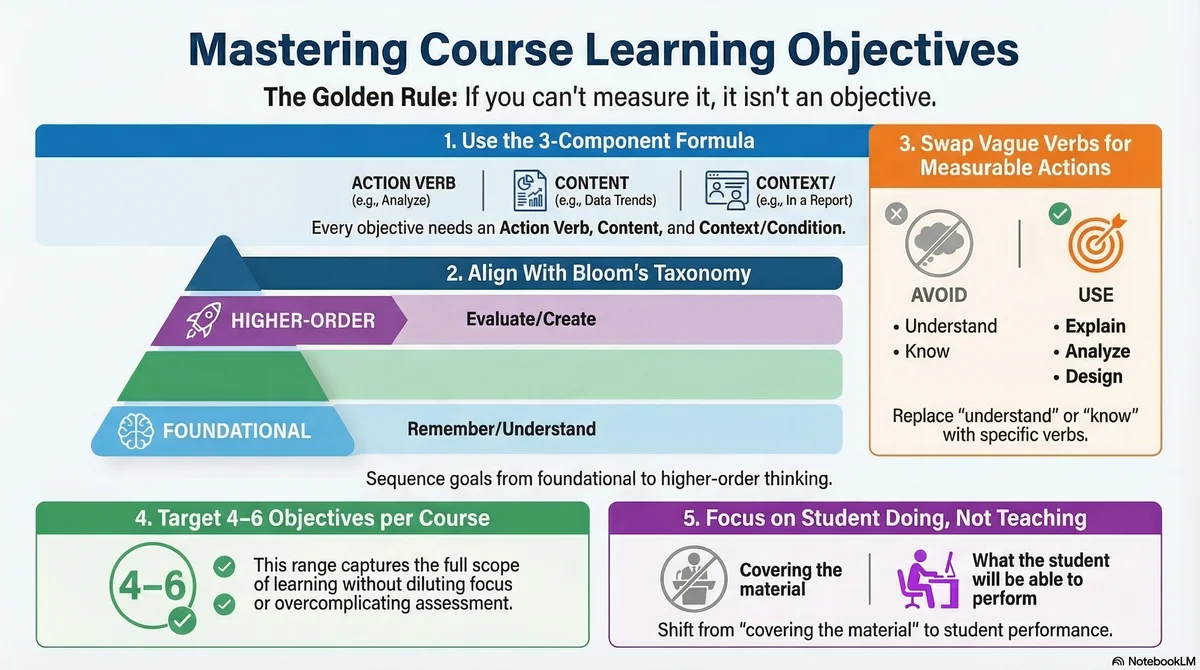
Course learning objectives (also called course learning outcomes or CLOs) are specific statements that describe what students will be able to do by the end of your course. They're not about what you'll teach — they're about what students will demonstrate.
A strong learning objective has three components:
- An action verb — what the student will do (measurable)
- Content or subject matter — what they'll apply the action to
- Context or condition — under what circumstances or to what standard
Example: "By the end of this course, students will be able to analyze (verb) primary source documents from the Civil Rights era (content) to construct evidence-based historical arguments (context)."
Bloom's Taxonomy: A Quick Refresher
Bloom's Taxonomy organizes cognitive skills into six levels, from foundational to advanced:
| Level | Description | Example Verbs |
|---|---|---|
| Remember | Recall facts and basic concepts | define, list, identify, name, recall |
| Understand | Explain ideas or concepts | describe, explain, summarize, interpret |
| Apply | Use information in new situations | apply, demonstrate, solve, implement |
| Analyze | Draw connections among ideas | analyze, compare, contrast, examine |
| Evaluate | Justify a decision or course of action | evaluate, argue, defend, critique |
| Create | Produce new or original work | design, construct, develop, formulate |
A well-designed course includes objectives across multiple levels — not just "Remember" and "Understand."
Step-by-Step: Writing Your Course Learning Objectives
Step 1: Start With the End in Mind
Before writing any objectives, ask yourself:
- What should students be able to do after completing this course that they couldn't do before?
- What skills or knowledge are essential for the next course in the sequence?
- What would demonstrate mastery to a colleague in your field?
Write down 3-5 informal answers. These become the raw material for your formal objectives.
Step 2: Choose Action Verbs at the Right Bloom's Level
Replace vague verbs with specific, measurable ones. Here's what to avoid and what to use instead:
| Instead of... | Use... | Bloom's Level |
|---|---|---|
| "Understand the principles of..." | "Explain the principles of..." | Understand |
| "Know the major theories..." | "Compare and contrast major theories..." | Analyze |
| "Be familiar with..." | "Identify and classify..." | Remember / Analyze |
| "Appreciate the importance of..." | "Evaluate the impact of..." | Evaluate |
| "Learn about..." | "Describe..." or "Analyze..." | Understand / Analyze |
The key rule: if you can't measure it, it's not an objective. You can measure whether a student can "analyze" something. You can't measure whether they "appreciate" it.
Step 3: Aim for 4-6 Course-Level Objectives
More than six objectives become difficult to assess meaningfully in a single course. Fewer than three may not capture the full scope of learning. The sweet spot is 4-6 objectives that span at least three levels of Bloom's Taxonomy.
Step 4: Align Objectives Across the Course
Each course-level objective should connect to specific modules. Map them out:
| Course Objective | Modules |
|---|---|
| CLO 1: Analyze primary source documents... | Modules 2, 4, 6 |
| CLO 2: Evaluate competing historical interpretations... | Modules 5, 7, 8 |
| CLO 3: Construct evidence-based arguments... | Modules 6, 7, 8 |
This alignment ensures your course builds progressively toward its goals.
Examples Across Disciplines
Psychology (Introductory)
- Remember: Identify the major schools of thought in psychology and their key contributors.
- Understand: Explain how biological, cognitive, and social factors influence human behavior.
- Apply: Apply psychological concepts to analyze real-world scenarios and case studies.
- Evaluate: Critically evaluate research methodologies used in published psychological studies.
Computer Science (Data Structures)
- Understand: Describe the properties, operations, and use cases of fundamental data structures including arrays, linked lists, trees, and hash tables.
- Apply: Implement data structures in code to solve computational problems.
- Analyze: Analyze the time and space complexity of algorithms using Big-O notation.
- Evaluate: Select and justify appropriate data structures for given problem constraints.
Business (Marketing Principles)
- Understand: Explain core marketing concepts including segmentation, targeting, positioning, and the marketing mix.
- Apply: Develop a marketing plan for a product or service using market research data.
- Analyze: Analyze consumer behavior patterns and their implications for marketing strategy.
- Create: Design an integrated marketing campaign that addresses a specific business challenge.
Common Mistakes to Avoid
-
Writing teaching objectives instead of learning objectives. "Cover the major theories of..." describes what you'll do, not what students will learn.
-
Using unmeasurable verbs. "Understand," "know," "appreciate," "be aware of" — these can't be assessed directly. Always pair them with a measurable action.
-
Pitching everything at the same Bloom's level. If all your objectives start with "Identify" or "Describe," your course isn't pushing students to higher-order thinking.
-
Writing too many objectives. Eight or more course-level objectives dilute focus. Consolidate where possible.
-
Not revisiting objectives after course design. Your objectives should be living documents. After designing your modules and assessments, revisit your CLOs to ensure alignment.
Putting It All Together
Strong learning objectives are the backbone of effective course design. They tell students what's expected, guide your assessment design, and keep your course focused. Using Bloom's Taxonomy ensures you're challenging students across cognitive levels — not just asking them to memorize and repeat.
The next time you sit down to design or revise a course, start here. Write your objectives first, align them with your modules, and let them guide every decision that follows.
Need help generating learning objectives for your course? CourseDev automatically creates Bloom's Taxonomy-aligned learning objectives, complete module content, assessments, and more — from just your course details or an uploaded syllabus. Try it free.