
You know the pattern. You post a discussion prompt on Monday. By Wednesday, you have 25 responses that all say some version of "I agree with the reading because it makes a lot of good points." Two required replies later, the thread is dead.
The problem isn't that students don't care. It's that most discussion prompts don't give them anything interesting to do.
Writing prompts that generate actual conversation — the kind where students push back on each other, bring in their own experiences, and leave thinking differently — is a skill. And like most teaching skills, it's learnable. Here's how.
Why Most Discussion Prompts Fall Flat
The majority of discussion prompts in higher education ask students to do one of two things: summarize or agree. "What are the key points from Chapter 5?" is a summary. "Do you think the author's argument is valid?" is a yes/no dressed up as a discussion.
Neither one creates the tension that drives real conversation. Good discussions need disagreement, stakes, or a genuine problem to solve. Without those, students are just performing participation for points.
The Anatomy of a Strong Prompt
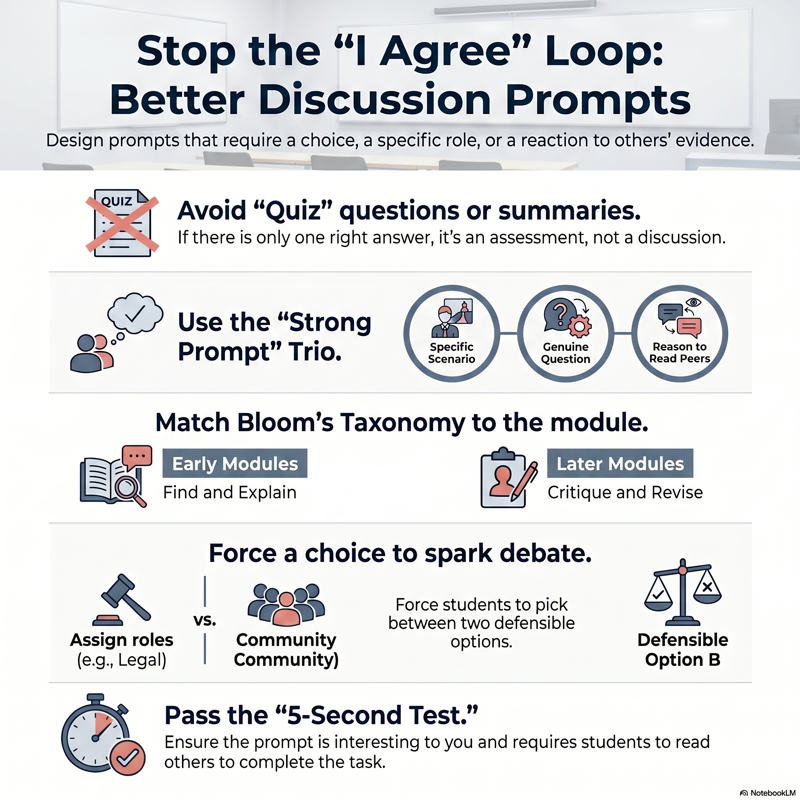
Every effective discussion prompt has three elements:
1. A specific scenario or constraint. Don't ask students to discuss a topic in the abstract. Give them a case, a dataset, a scenario, or a perspective to react to. Specificity gives students something to grab onto.
2. A genuine question — not a quiz question. If there's one right answer, it's an assessment, not a discussion. The best prompts have multiple defensible positions.
3. A reason to read other responses. If students can write their post without reading anyone else's, the "discussion" is really just a series of parallel essays. Build in a mechanism — a limited-choice constraint, a role assignment, or a direct reply requirement — that makes engagement necessary.
Prompts by Bloom's Taxonomy Level
Not every discussion needs to be a philosophical debate. Match the cognitive level to where students are in the course. Early modules benefit from lower-level prompts that build confidence; later modules should push into analysis, evaluation, and creation.
For a deeper dive into cognitive levels, see our guide to Bloom's Taxonomy and learning objectives.
Remember / Understand (Early Modules)
These prompts help students engage with foundational concepts without oversimplifying:
"Find a real-world example of [concept] that wasn't mentioned in the readings. Explain why it qualifies in 2-3 sentences. Then read your classmates' examples — reply to one where you think the example might not actually fit, and explain why."
This is still recall-level, but the "challenge a classmate's example" step creates genuine back-and-forth.
Apply / Analyze (Mid-Course)
"You've been hired as a consultant for [scenario]. Based on what we've covered in Modules 1-4, what's your recommendation? You must choose one of two options [Option A or Option B] and defend your choice with evidence from the course material. Read two classmates who chose the opposite option — reply to the one whose argument is strongest and explain what they got right."
The forced choice eliminates fence-sitting. Requiring students to engage with the strongest opposing argument — not the weakest — raises the quality of every reply.
Evaluate / Create (Later Modules)
"Here is a [real proposal / published study / policy recommendation]. Identify one significant flaw in the methodology, evidence, or reasoning. Then propose a specific revision that would address it. Your revision must be realistic given the constraints described in the original."
At this level, students aren't just reacting — they're building. The constraint ("realistic given the constraints") prevents the easy critique of "they should have done everything differently."
Format Variations That Work
The Role-Based Prompt
Assign students different perspectives before they discuss. In a business ethics course: "Group A, you're the company's legal counsel. Group B, you're the affected community. Group C, you're a shareholder." Same scenario, different stakes — instant disagreement.
The Evidence-Limited Prompt
Give students access to different sources and ask them to argue from only what they've been given. This mimics real-world decision-making where information is incomplete and forces students to engage with classmates who have different evidence.
The "Change My Mind" Prompt
Students post a position, then read responses designed to challenge it. In their final reply, they must either revise their position or explain specifically why the counterarguments didn't convince them. This rewards intellectual honesty over stubbornness.
Online vs. In-Person Discussions
The format changes the prompt design. Online courses benefit from prompts that give students time to think and research before responding — leaning into the asynchronous advantage. In-person discussions need prompts that are immediately accessible without prep.
For hybrid courses, consider splitting the work: post the prompt online before class so students arrive with a position, then use face-to-face time for the debate. The online thread becomes the preparation, not the discussion itself.
Common Mistakes
1. Too many prompts. One strong discussion per module is better than three weak ones. Students invest more when there are fewer, higher-quality opportunities.
2. No rubric, or a rubric that rewards word count. Students will write to whatever you measure. If you measure length, you get filler. If you measure evidence use and peer engagement, you get substance.
3. "Respond to at least two classmates." This requirement creates the worst replies in higher education. Instead, build the reply into the prompt itself — make engaging with others part of the task, not a checkbox.
4. Posting prompts that you wouldn't want to answer. Seriously — read your prompt and ask yourself if you'd find it interesting. If you'd struggle to write more than a paragraph, your students will too.
A Note on Volume
If you're teaching multiple sections — especially as an adjunct managing several course preps — writing fresh, high-quality prompts for every module of every course is unsustainable. This is one of those tasks where AI tools built for course design earn their value. Generate a batch of prompts at different Bloom's levels, then curate and customize the best ones. Starting from ten options and picking three is faster than staring at a blank page trying to write one.
The Test
Before you post a discussion prompt, run it through this checklist:
- Does it have more than one defensible answer?
- Would you find it interesting to respond to?
- Does a student need to read others' posts to complete the task?
- Is it specific enough that students can't answer with generalities?
- Does it match the cognitive level appropriate for this point in the course?
If you hit all five, you've got a prompt worth posting.
Every module CourseDev generates includes discussion prompts with rubrics — matched to your learning objectives and ready to customize. Try it free.