
You just got assigned a new course. Maybe it's two weeks before the semester starts. Maybe it's a subject you know well but have never formally taught. Either way, the clock is ticking and you need a plan.
This checklist is designed for adjunct professors who need to prepare a course efficiently — without sacrificing quality. Use it as a step-by-step guide from the moment you accept a course assignment to the first day of class.
Phase 1: Before You Start Building (Days 1-2)
Gather Your Constraints
Before writing a single word of content, get clear on what you're working with:
- Confirm the course details — title, section number, credit hours, meeting times, modality (online, hybrid, face-to-face)
- Get the department syllabus template — many departments have required elements (policies, disability statements, academic integrity language)
- Check for a master syllabus or course description — some programs have mandated learning outcomes or textbooks
- Identify the LMS — Canvas, Blackboard, Moodle, D2L? Get access and familiarize yourself with the basics
- Confirm your textbook or OER options — is a textbook required, recommended, or your choice?
- Note key dates — add/drop deadlines, holidays, final exam period, grade submission deadline
Know Your Students
- Check enrollment numbers — this affects your activity and assessment choices
- Ask about student demographics — first-generation students? Working adults? This shapes your approach
- Check prerequisites — what can you assume students already know?
Phase 2: Course Architecture (Days 3-5)
Design the Skeleton
- Write 4-6 course learning objectives — use Bloom's Taxonomy action verbs (see our guide to writing learning objectives)
- Map your module/week structure — divide the semester into logical units
- Plan your assessment strategy:
- What percentage for participation/discussions?
- How many assignments or projects?
- Midterm and/or final exam?
- Quizzes (if any)?
- Create a grading breakdown — be explicit about weights
- Draft a course schedule — topics by week with key due dates
Build Your Syllabus
- Use the department template as your starting point
- Include required institutional policies — academic integrity, accessibility, Title IX
- Add your contact info and office hours — even virtual office hours count
- Clearly state your communication policy — email response time, preferred contact method
- Include your late work policy — be specific and fair
- Add the grading scale — don't assume students know it
Phase 3: Module Content (Days 5-10)
Build Each Module
For each module or week, prepare:
- Module overview — what this module covers and why it matters
- Learning objectives — 2-4 specific, measurable objectives per module
- Required readings or resources — with page numbers or links
- Lecture content or talking points — slides, notes, or recorded lectures
- Discussion prompts — at least one per module for online/hybrid courses
- Activities or exercises — in-class or asynchronous
- Assessment — quiz, assignment, or project milestone
Prioritize Ruthlessly
You don't need every module fully built before day one. At minimum, have:
- Weeks 1-3 fully prepared — gives you a runway
- Weeks 4-8 outlined — topics, readings, and assessments identified
- Weeks 9+ sketched — at least a topic and basic plan
This "rolling prep" approach is how most experienced adjuncts manage multiple preps.
Phase 4: LMS Setup (Days 8-12)
- Create your course shell in the LMS
- Upload your syllabus as the first item students see
- Set up your module/week structure — mirror your syllabus schedule
- Create assignment submission points with due dates and instructions
- Set up the gradebook — match your syllabus grading breakdown
- Post a welcome announcement — introduce yourself, set expectations
- Test student view — navigate the course as a student would
Phase 5: First-Day Readiness (Days 12-14)
- Print or share your syllabus — even if it's in the LMS, walk through it on day one
- Prepare a first-day activity — an icebreaker, a diagnostic quiz, or a discussion that sets the tone
- Have a backup plan — if tech fails, if the room changes, if enrollment doubles
- Test all technology — projector, microphone, Zoom link, screen sharing, LMS access
- Prepare your personal introduction — keep it brief, warm, and relevant
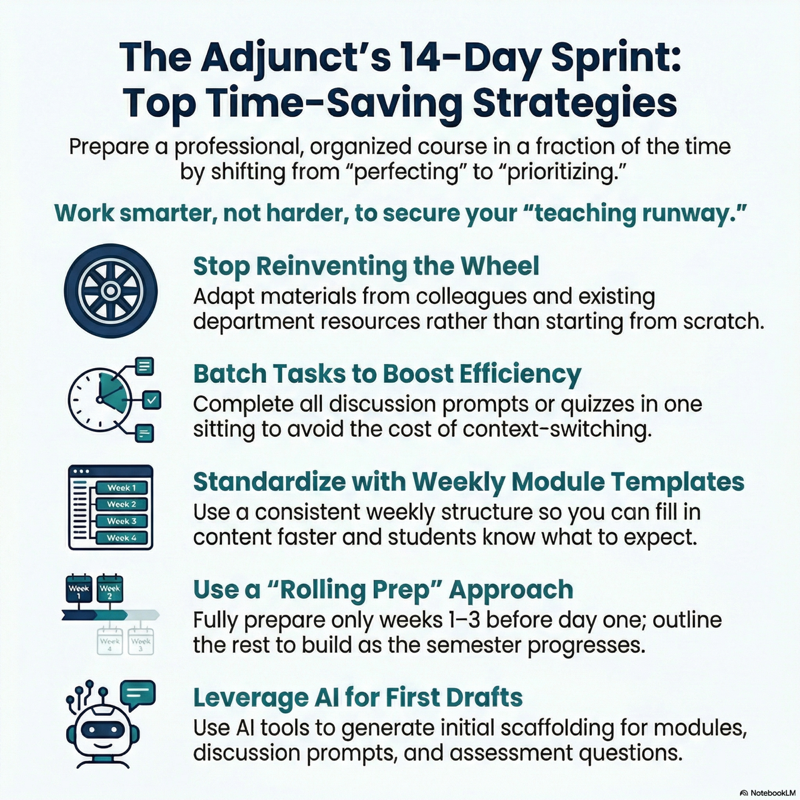
Time-Saving Strategies for Adjuncts
1. Don't Reinvent the Wheel
Ask colleagues who've taught the course before for their materials. Most are happy to share. Adapt rather than create from scratch.
2. Batch Your Prep
Instead of preparing one module at a time, batch similar tasks: write all discussion prompts in one session, all quizzes in another. Context-switching is expensive.
3. Use Templates
Create a consistent module template — same sections in the same order every week. Students know what to expect, and you can fill in content faster.
4. Front-Load Your Grading Strategy
Choose assessments that are meaningful but efficient to grade. Rubrics save enormous time. Peer review can handle some of the load.
5. Leverage AI for First Drafts
AI tools can generate initial drafts of module content, discussion prompts, and assessment questions. You provide the expertise and final edits — the tool handles the scaffolding.
The Two-Week Sprint Template
Here's a realistic timeline if you have 14 days before the semester:
| Days | Focus | Deliverable |
|---|---|---|
| 1-2 | Gather constraints, know your students | Completed intake checklist |
| 3-4 | Course objectives, module map, assessment plan | Course skeleton document |
| 5-6 | Syllabus draft | Complete syllabus |
| 7-9 | Modules 1-3 full content | Three ready-to-teach modules |
| 10-11 | LMS setup | Course shell live |
| 12-13 | Modules 4-6 outlined, first-day prep | Runway secured |
| 14 | Final review, test everything | Ready to teach |
Is it tight? Yes. Is it doable? Absolutely — thousands of adjuncts do this every semester.
Final Thought
The goal isn't a perfect course on day one. The goal is a well-structured, clearly communicated course that you can improve as you go. Your students don't need perfection — they need an organized, prepared, and engaged instructor. That's you.
Building a course from scratch? CourseDev generates complete module content — learning objectives, discussions, assignments, assessments, talking points, and resources — from your course details or an uploaded syllabus. Create your first course free.