
Here's an uncomfortable truth about higher education: the feedback most students receive on their work is either too late to matter, too vague to act on, or both. "Good work" written on an essay three weeks after submission doesn't teach anyone anything. "Needs improvement" without specifics is just a grade with extra words.
The problem isn't that instructors don't care about feedback. It's that giving meaningful, individualized feedback at scale is genuinely one of the hardest parts of teaching. When you have 75 discussion posts, 40 essays, and a stack of lab reports all due the same week, something has to give.
This guide is about making that tradeoff less painful — giving feedback that's faster for you and more useful for students.
Why Feedback Matters More Than the Grade
Research on learning is clear on this: students learn more from feedback than from grades. A letter grade tells a student where they landed. Feedback tells them how to get better. Yet most of our assessment infrastructure — gradebooks, GPA calculations, transcript formatting — is built around the grade, not the feedback.
This creates a paradox. The thing that matters most for learning (feedback) takes the most time, while the thing that matters least for learning (the grade) is what institutions require. You can't eliminate grading, but you can design a system where feedback is efficient enough to actually happen.
The Rubric Is the Strategy
If you take one thing from this post, let it be this: a well-designed rubric isn't a grading shortcut — it's a feedback delivery system.
A strong rubric does three things simultaneously:
- Tells students what's expected before they submit
- Speeds up your grading by turning evaluation into pattern-matching
- Delivers specific feedback through criterion-level descriptions
What a Useful Rubric Looks Like
The rubrics that save time share a few traits:
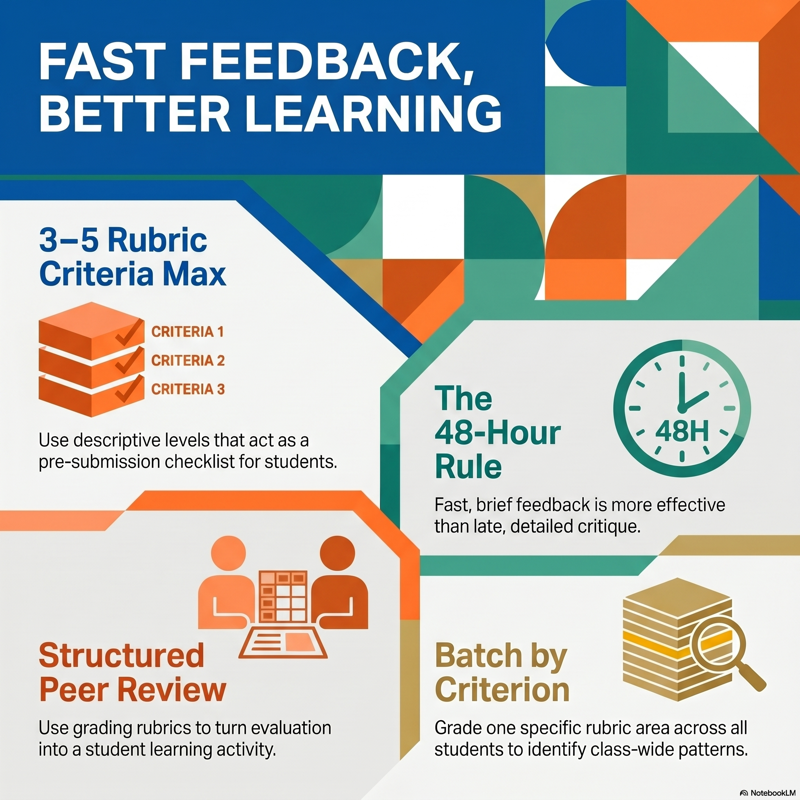
- 3-5 criteria maximum. More than five and you're spending as long on the rubric as you would writing comments. Focus on what matters most for the learning objective.
- Descriptive levels, not just labels. "Excellent / Good / Needs Work" tells students nothing. "Evidence includes three or more peer-reviewed sources with clear connections to the thesis" tells them exactly what to aim for.
- Language students can reuse. Write rubric descriptions in a way that students can read before submitting and use as a checklist. If your rubric only makes sense after grading, it's not doing its job.
If you're building rubrics from scratch for every assignment, that's where the time drain starts. Generating rubric drafts from your learning objectives and then customizing them is dramatically faster than writing from a blank page.
Feedback Timing: Earlier Beats Better
A detailed, beautifully written piece of feedback returned three weeks after submission is less effective than three bullet points returned in three days. Students have moved on. They've already submitted the next assignment using the same habits you're about to critique.
The 48-Hour Rule
Aim to return feedback within 48 hours of submission. Not because it's a universal best practice, but because it hits the window where students still remember what they were thinking when they wrote it. They can connect your comments to their decisions.
Can't grade 40 essays in 48 hours? You don't have to. Try these approaches:
Batch by criterion, not by student. Read all 40 essays for thesis clarity first, then all 40 for evidence quality. You'll be faster and more consistent — and you'll spot patterns that let you write one piece of class-wide feedback instead of 40 individual comments.
Use a "feedback first, grade later" approach. Return rubric-based feedback immediately, and add the final grade a day later. Students read the feedback when it's the only thing there. Once a grade appears, most stop reading.
Prioritize formative over summative. Your detailed feedback energy should go toward assignments students will revise or build on. For final submissions with no revision opportunity, a rubric score with brief comments is enough.
Peer Review: The Underused Tool
Peer review isn't just a way to reduce your grading load — it's a learning activity in its own right. Students who evaluate others' work develop a better eye for quality in their own.
But unstructured peer review ("read your partner's essay and give feedback") produces terrible results. Students either write "looks good!" or tear each other apart without constructive suggestions.
Structure it with the same rubric you'll use for grading. Give students the exact rubric criteria and ask them to evaluate one or two specific dimensions — not the whole assignment. This teaches them to read evaluatively and gives you a head start on identifying which submissions need the most attention.
For online and hybrid courses, peer review also solves an engagement problem. It gives students a reason to interact with each other's work beyond discussion boards.
The Volume Problem: Teaching Multiple Sections
If you're an adjunct teaching three or four sections, the math is brutal. Four sections of 30 students, each submitting weekly work — that's 120 items to provide feedback on, every week, on top of your other preps.
Strategies that scale:
- Stagger due dates across sections. If Section A submits Tuesdays and Section B submits Thursdays, you never face the full pile at once.
- Alternate depth. Give detailed rubric feedback on major assignments. For low-stakes weekly work, a completion grade with brief class-wide comments is sufficient.
- Record a 5-minute video. After grading a batch, record a short video addressing the three most common issues you saw. Post it for the whole class. This replaces writing the same comment 25 times.
- Build rubrics and assignments that reduce your grading surface area. Fewer, more intentional assessments aligned to your course outline produce better learning outcomes than weekly busywork — and give you your weekends back.
What Students Actually Want
Studies consistently show that students value feedback that is:
- Specific — points to exact moments in their work, not generalities
- Actionable — tells them what to do differently next time
- Timely — arrives while they still care about the assignment
- Connected to criteria — references the rubric or learning objectives so they know what standard they're being measured against
Notice what's not on the list: length. Students don't want a 500-word essay about their essay. They want three specific things they can do better. That's freeing — it means effective feedback can also be fast feedback.
Build the System, Then Teach Within It
The instructors who maintain high-quality feedback without burning out aren't working harder — they've built a system. Rubrics aligned to objectives. Staggered deadlines. Peer review for formative work. Brief recorded walkthroughs for common issues. Every piece of the system reduces the per-student grading cost while keeping feedback meaningful.
The upfront investment is real — building rubrics, designing peer review protocols, aligning assessments to your objectives. But that's design work you do once and reuse every semester. And it's exactly the kind of structural work where AI course design tools save the most time: generating rubric drafts, assessment frameworks, and grading criteria that you refine and make your own.
CourseDev generates assessment rubrics and grading criteria aligned to your learning objectives — for every module, ready to customize. Try it free.