
A course outline is the structural backbone of any college or university course. It's the document that connects your learning objectives to your weekly topics, assessments, and activities — giving both you and your students a clear roadmap for the semester.
Yet many instructors skip this step, jumping straight from a course description to building slides or uploading content into the LMS. The result is a course that feels improvised, with misaligned assessments and modules that don't build on each other.
This guide walks you through how to create a course outline from scratch — whether you're designing a brand-new course or restructuring an existing one.
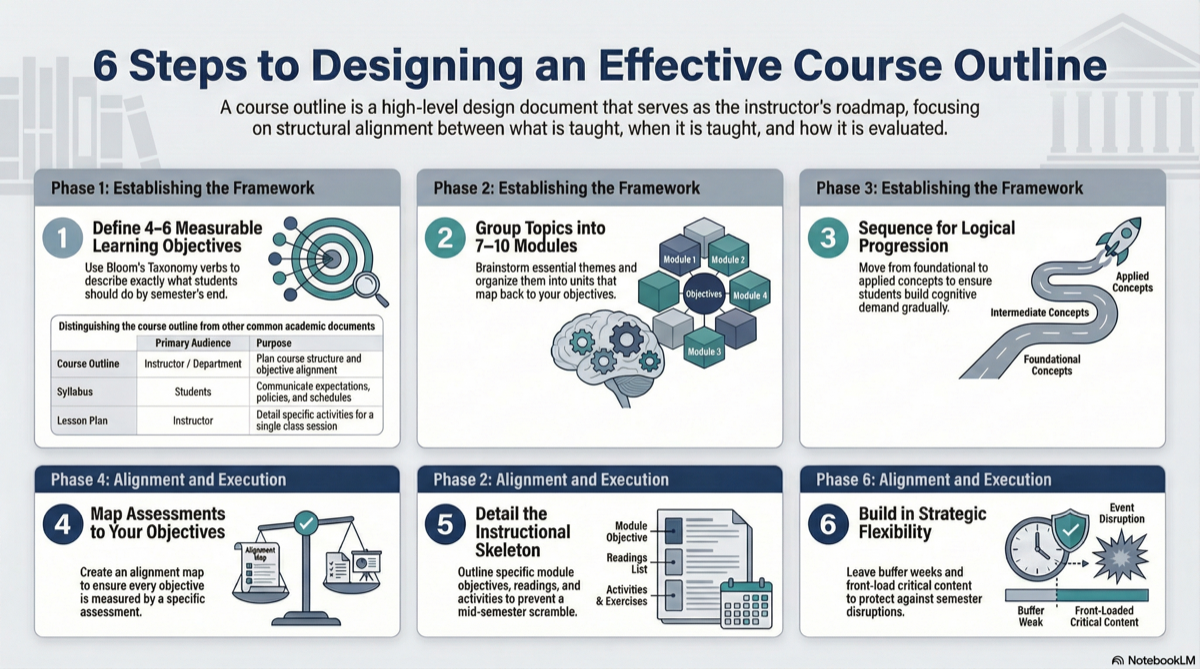
What Is a Course Outline?
A course outline is a high-level planning document that maps out:
- What students will learn (learning objectives)
- When they'll learn it (module/week sequence)
- How they'll demonstrate learning (assessments and activities)
- Why each piece matters (alignment between objectives, content, and evaluation)
It's not the same as a syllabus. A syllabus is a student-facing document with policies, schedules, and contact information. A course outline is a design document — it may inform your syllabus, but its primary audience is you.
| Document | Audience | Purpose |
|---|---|---|
| Course outline | Instructor (and department) | Plan the structure and alignment of the course |
| Syllabus | Students | Communicate expectations, policies, and schedule |
| Lesson plan | Instructor | Detail a single class session or module |
Step 1: Start With Your Course Learning Objectives
Before deciding what to teach in Week 3, you need to know what students should be able to do by the end of the course. Course learning objectives (CLOs) are the foundation of your outline.
Write 4–6 course-level objectives using measurable action verbs from Bloom's Taxonomy:
| Bloom's Level | Example Objective |
|---|---|
| Remember | Identify the major components of a marketing plan |
| Understand | Explain how supply and demand interact in competitive markets |
| Apply | Apply statistical methods to analyze real-world datasets |
| Analyze | Compare competing theories of organizational behavior |
| Evaluate | Evaluate the ethical implications of emerging technologies |
| Create | Design a research proposal using appropriate methodology |
Avoid vague verbs like "understand," "know," or "appreciate" — if you can't assess it, it's not an objective.
For a deeper dive, see our guide to writing learning objectives using Bloom's Taxonomy.
Step 2: Identify Your Major Topics and Themes
With your CLOs in hand, brainstorm the major topics your course needs to cover. Don't worry about order yet — just list everything that's essential.
Then group related topics into modules or units. Most semester-length courses work well with 7–10 modules (not necessarily one per week). Modules that span two weeks allow deeper engagement with complex topics.
Example — Introduction to Sociology:
- The Sociological Imagination
- Research Methods in Sociology
- Culture and Society
- Socialization and Identity
- Social Stratification and Inequality
- Race, Ethnicity, and Gender
- Institutions: Family, Education, Religion
- Deviance and Social Control
Each module should map back to at least one course learning objective.
Step 3: Sequence Your Modules
Order matters. Effective course outlines follow a logical progression:
- Foundational → Applied — teach concepts before asking students to use them
- Simple → Complex — build cognitive demand gradually
- Concrete → Abstract — ground theory in examples first
Ask yourself: Does a student need Module 2 to succeed in Module 5? If yes, the sequence is correct. If modules are independent, group them thematically.
A Common Sequencing Pattern
| Phase | Modules | Purpose |
|---|---|---|
| Foundation | 1–2 | Core concepts, terminology, frameworks |
| Development | 3–6 | Deeper exploration, application, analysis |
| Integration | 7–8 | Synthesis, evaluation, capstone work |
This three-phase pattern works across disciplines — from humanities to STEM.
Step 4: Map Assessments to Objectives
Every assessment in your course should connect to at least one course learning objective. If an assessment doesn't serve an objective, question whether it belongs.
Create an alignment map:
| Course Learning Objective | Assessment(s) | Module(s) |
|---|---|---|
| CLO 1: Identify major sociological theories | Quiz 1, Midterm Exam | 1, 2 |
| CLO 2: Apply research methods to social questions | Research Methods Assignment | 2, 3 |
| CLO 3: Analyze social inequality through multiple lenses | Essay 1, Group Discussion | 4, 5, 6 |
| CLO 4: Evaluate policy proposals using sociological evidence | Policy Brief (Final Project) | 7, 8 |
This map reveals gaps immediately. If a CLO has no assessment tied to it, students won't be evaluated on that skill — which means it's effectively not part of the course.
Assessment Types to Consider
- Formative (low-stakes, ongoing): quizzes, discussion posts, reflections, peer reviews
- Summative (high-stakes, evaluative): exams, essays, projects, presentations
- Authentic (real-world application): case analyses, simulations, portfolio work
A strong course outline includes a mix. Over-relying on exams misses students who demonstrate mastery through application and synthesis.
Step 5: Plan Module-Level Details
For each module, outline:
- Module title — clear and descriptive
- Module learning objectives — 2–4 per module, tied to your CLOs
- Key topics and subtopics — what you'll cover
- Readings and resources — textbook chapters, articles, videos
- Activities — discussions, exercises, labs, case studies
- Assessment — what students submit and when
You don't need every detail now. The outline is a skeleton — you'll flesh it out as you build content. But having this structure prevents the "what am I teaching next week?" scramble mid-semester.
Step 6: Build in Flexibility
No course outline survives the semester unchanged. Build in buffer:
- Leave one week unassigned — use it for review, catch-up, or a topic students want to explore deeper
- Front-load critical content — if the semester gets disrupted, your core objectives are already covered
- Mark "nice to have" vs. "must cover" for each module — so you know what to cut if time runs short
Putting It All Together: Course Outline Template
Here's a template you can adapt for any course:
Course: [Title and Number] Credits: [Credit Hours] Modality: [Online / Hybrid / Face-to-Face] Term: [Semester and Year]
Course Description: [2–3 sentence overview]
Course Learning Objectives:
- [CLO 1]
- [CLO 2]
- [CLO 3]
- [CLO 4]
Assessment Overview:
| Assessment | Weight | CLO Alignment |
|---|---|---|
| Participation & Discussions | 15% | CLO 1, 2 |
| Assignments (3) | 30% | CLO 2, 3 |
| Midterm Exam | 20% | CLO 1, 2 |
| Final Project | 35% | CLO 3, 4 |
Module Sequence:
| Module | Topic | CLOs | Key Assessment |
|---|---|---|---|
| 1 | [Topic] | 1 | Discussion |
| 2 | [Topic] | 1, 2 | Quiz 1 |
| 3 | [Topic] | 2 | Assignment 1 |
| ... | ... | ... | ... |
Common Mistakes to Avoid
-
Cramming too much into one course. If your outline has 14 modules for a 15-week semester, there's no room for depth or flexibility. Consolidate.
-
Listing topics without objectives. A list of weekly topics isn't an outline — it's a table of contents. Each module needs learning objectives that connect to your CLOs.
-
Saving the hardest material for last. Students are most engaged early in the semester. Introduce challenging concepts while energy is high, then reinforce later.
-
Ignoring assessment alignment. If your final exam tests content from Module 2 but your CLOs emphasize analysis and creation, something is misaligned.
-
Treating the outline as final. Your outline is a living document. Revisit it after each semester and adjust based on what worked and what didn't.
From Outline to Fully Built Course
A solid course outline typically takes 3–5 hours to create manually. From there, building out full module content — learning objectives, readings, discussion prompts, assignments, rubrics, assessments, and talking points — can take weeks.
That's where the right tools make a difference. Whether you build out your modules by hand or use a tool to generate first drafts, the outline ensures everything stays aligned and purposeful.
Ready to turn your outline into a complete course? CourseDev takes your course details and generates full module content — objectives, discussions, assignments, assessments, and more — aligned to your learning outcomes. Try it free.