
Course design for community college faculty is a different kind of challenge. You're not designing for a homogeneous cohort with four years of runway. You're designing for working adults, first-generation students, returning veterans, high schoolers in dual-enrollment, and 18-year-olds figuring out what they want to do — sometimes all in the same section. Often on a compressed schedule. Frequently with very little institutional support.
This guide is for faculty in that world. Not the glossy, conference-keynote version of course design — the real one, where you have two weeks of prep time, three different course preps, and students who need the class to actually work.
What Makes Community College Course Design Different
Before getting into the how, it's worth naming what's actually different about course design community college faculty face compared to their four-year peers.
Compressed timelines. Summer terms run four to eight weeks. Late-start sections can squeeze a 16-week course into 12. Students enroll the night before classes start. You rarely get a full semester to pace out content at a relaxed tempo.
Diverse preparation levels. In a single section you may have a student who just finished AP coursework sitting next to one who hasn't taken a math class in fifteen years. Designing around "the average student" doesn't work when the variance is that wide.
Limited prep time. Most community college faculty — especially adjuncts — are juggling multiple courses across multiple institutions. The idea of spending 80 hours designing a single course is a fantasy. You need a framework that gets you to "ready to teach" fast without cutting corners on quality.
Students with real lives. Many of your students work full time, have kids, commute long distances, and rely on the class actually helping them. Course design isn't abstract — it directly affects whether someone can pass, transfer, or get a promotion.
Good course design community college faculty use accounts for all of this from the start.
Step 1: Start With What Students Actually Need to Walk Away With
Every strong course design starts with clear learning objectives. For community college courses, that means being especially disciplined about what matters.
Ask yourself: if a student takes nothing else away, what are the three or four things they must be able to do by the end of this course? Those become your anchor objectives. Everything else either supports them or gets cut.
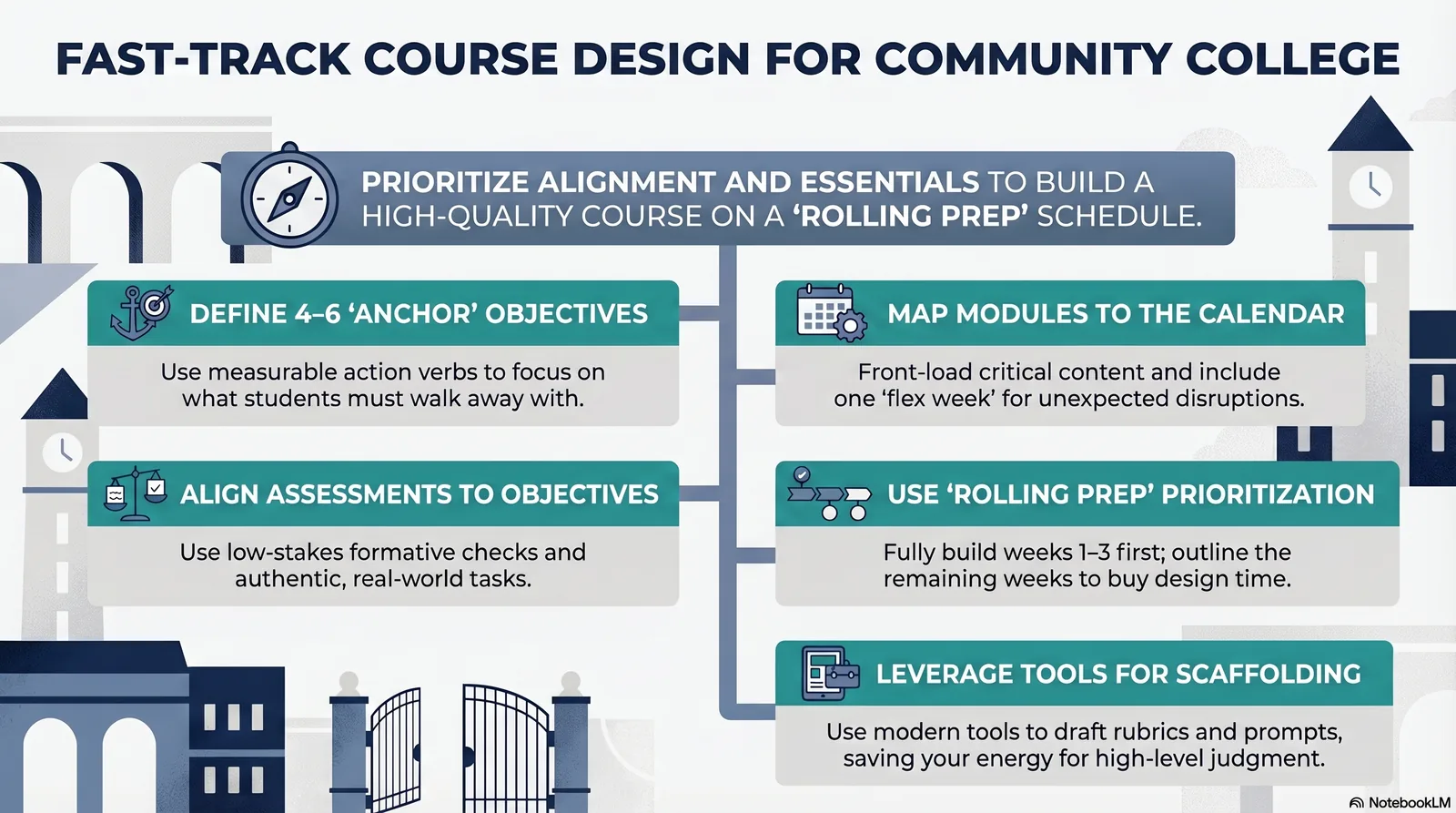
Write 4-6 course-level objectives using measurable action verbs — we cover the full approach in our guide to writing course learning objectives with Bloom's Taxonomy. Avoid vague language like "understand" or "be familiar with." You and your students both need to know when an objective has been met.
Step 2: Build a Module Structure That Respects the Calendar
This is where course design community college reality kicks in. A 16-week course and an 8-week summer section are not the same animal. You can't just cut content in half and expect the same learning outcomes.
A few structural rules that work:
- Front-load the critical content. If a student withdraws in week 3 of an 8-week course, they should still have gotten the most important material.
- Group related topics into modules. Seven to ten modules works for a standard semester. For compressed formats, four to six modules with tighter focus is more realistic.
- Leave a flex week. Something always disrupts the schedule — a snow day, a tech outage, a week where students clearly need more time. Plan for it.
If you're designing an online version, our step-by-step online course design guide walks through the module-level decisions in more detail. The same principles apply, but the pacing and engagement strategies shift when students aren't in a room with you.
Step 3: Design Assessments That Actually Measure Learning
Community college course design lives or dies on assessment alignment. Every assessment should connect directly to a learning objective. If you can't explain which objective an assignment measures, cut it or rework it.
Mix three types:
- Formative — low-stakes checks for understanding (quick quizzes, discussion posts, exit tickets) that help students gauge where they are without wrecking their grade
- Summative — higher-stakes evaluations (exams, projects, papers) that measure mastery at the end of a module or unit
- Authentic — tasks that look like what students will actually do after the course (case analyses, portfolios, applied projects)
For working students, authentic assessments are especially valuable. They transfer. A well-designed project a student can put on a résumé or use in their current job makes the course feel worth the time and money.
Step 4: Build Your Course Outline Before You Build Content
This is the step most faculty skip — and it's the most expensive one to skip. Before writing a single discussion prompt or assignment, map out the full structure: modules, topics, objectives, assessments, and how they all connect.
A solid course outline is your blueprint. Without one, you end up rebuilding the same decisions over and over as you go. With one, each module becomes a fill-in-the-blank exercise instead of a blank-page problem.
Step 5: Prioritize Ruthlessly — You Won't Have Time for Everything
You will not have time to build the perfect course before day one. Nobody does. The question is which parts you front-load.
Here's a prioritization order that works:
- Syllabus and schedule — students need these immediately
- Weeks 1-3 fully built — gives you a runway and buys you time
- Assessment structure and rubrics — students need to know how they're being graded
- Weeks 4-8 outlined — topics, readings, rough assignments
- Later weeks sketched — at least a topic and direction
Experienced community college faculty call this "rolling prep." It's not a workaround — it's the realistic way to manage multiple preps across a semester. Our adjunct professor course prep checklist walks through this sprint approach in detail.
Step 6: Use the Right Tools for the Scaffolding
Good course design community college faculty do today looks different from what it looked like ten years ago — and that's a good thing. You don't need to write every rubric, every discussion prompt, and every module overview from a blank page anymore. The scaffolding work that used to eat weekends can now be drafted in hours.
This is where modern tools earn their keep. Not for replacing your judgment about your students or your discipline, but for handling the repetitive structural work. Our guide on AI tools for educators that actually work breaks down where these tools help and where they fall short. The short version: use them for first drafts, not final ones.
Common Mistakes to Avoid
A few patterns that trip up community college course design:
- Designing for the top 20% of students. Your course needs to work for the whole room, not just the students who would've succeeded anywhere.
- Overloading the first two weeks. Students are still adding and dropping. Heavy early assessments punish students for enrollment churn that isn't their fault.
- Treating the outline as final. Your first semester teaching a course is a rough draft. Expect to revise after you see what actually works.
- Skipping rubrics. Without them, grading takes twice as long and students don't know what you want.
- Ignoring transfer alignment. If your course is meant to transfer to a four-year institution, check the receiving institution's expectations before finalizing.
A Realistic Course Design Workflow
Here's what a practical workflow looks like when you have two weeks before the semester starts:
- Day 1-2: Gather constraints — department requirements, course description, LMS access, textbook, calendar
- Day 3-4: Write course learning objectives and map modules
- Day 5-6: Build assessment structure and draft rubrics
- Day 7-9: Fully build modules 1-3
- Day 10-11: Outline modules 4-8 with topics and assessments
- Day 12-13: LMS setup and syllabus finalization
- Day 14: Test everything, prepare day-one materials
It's tight. It's doable. And it's how most community college faculty actually get courses ready every term.
Final Thought
Course design community college faculty do is some of the most consequential teaching work happening in higher education. Your students are often the ones who most need the class to work — and a well-designed course is the single biggest factor in whether it does. Perfect isn't the goal. Structured, aligned, and honest about the constraints is the goal. That's enough to build something your students will actually learn from.
Designing a course for an upcoming term? CourseDev generates complete course content — learning objectives, module materials, discussions, assignments, rubrics, and assessments — tailored to your course details or an uploaded syllabus. Review it, revise it, and make it yours. Try it free.