
There's a version of the AI-in-education conversation that goes like this: AI will write your course, grade your students, and eventually replace you. It's efficient. It's inevitable. Get on board or get left behind.
That version is wrong.
Not because AI can't generate course content — it can, and it's getting better at it. But because generating content was never the hard part of teaching. The hard part is knowing which content matters for your students, in your discipline, at this moment. That's judgment. And judgment is what educators bring that no model can replicate.
This post is about what your role actually looks like in the age of AI — and why it matters more, not less, than it did before.
What AI Can Do (Honestly)
Let's be specific about what AI does well in course design, because the vague claims in both directions aren't helpful.
AI is good at:
- Generating first drafts. Course outlines, module content, discussion prompts, assessment questions, rubrics — AI can produce reasonable starting points for all of these.
- Applying structure. Aligning learning objectives to Bloom's Taxonomy, mapping assessments to outcomes, maintaining consistent formatting across modules.
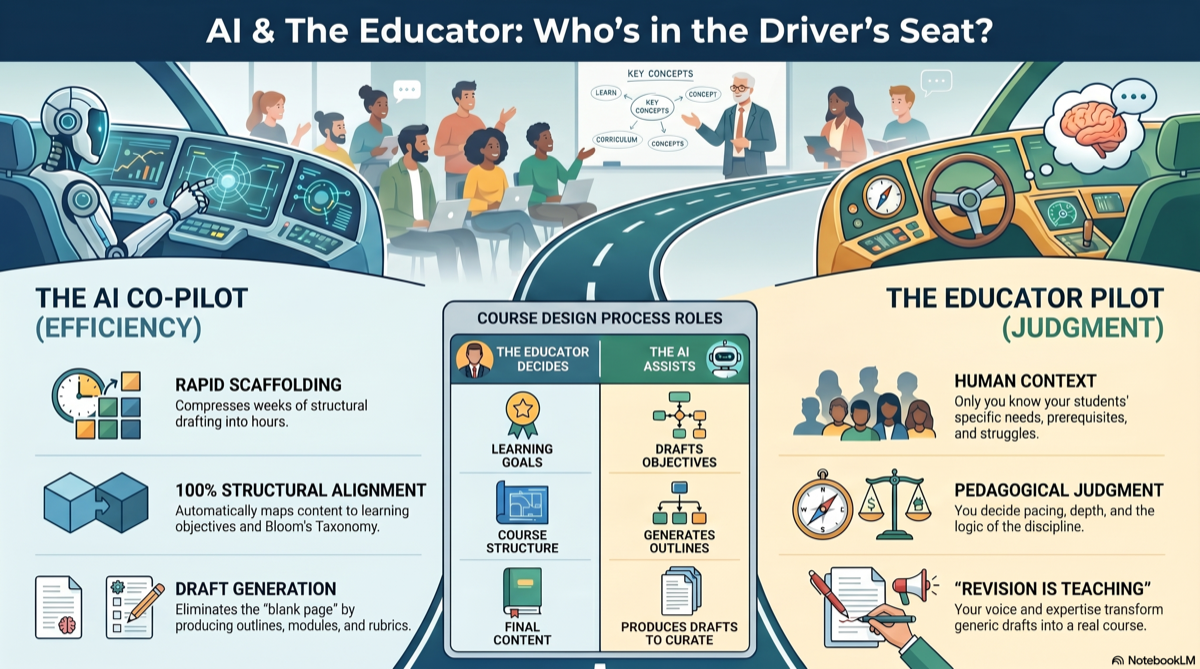
- Handling volume. Building eight modules of content — each with objectives, readings, activities, and assessments — is a massive amount of structural work. AI compresses weeks of scaffolding into hours.
- Reducing the blank-page problem. The hardest part of any creative task is starting. AI eliminates that friction.
These are real capabilities, and they save real time — especially for adjuncts managing multiple preps or faculty at community colleges where institutional support for course development is thin.
What AI Cannot Do (Also Honestly)
AI cannot:
- Know your students. It doesn't know that half your section works full-time, or that your institution just changed the prerequisite chain, or that last semester's cohort struggled with the statistics module because they came in with weak algebra skills. You know that. And that knowledge shapes every decision you make about pacing, depth, and emphasis.
- Make pedagogical judgment calls. Should Module 3 come before Module 4, or does your discipline's logic work better the other way? Should the midterm be cumulative or focused? Is this discussion prompt going to land with your specific student population? These are expert decisions, not pattern-matching tasks.
- Teach. AI generates materials. It doesn't read the room. It doesn't adjust mid-lecture when students look confused. It doesn't notice that a student who's been engaged all semester suddenly went quiet. Teaching is a human relationship, and no tool changes that.
- Carry your voice. Your course should sound like you — your examples, your priorities, your disciplinary perspective. AI-generated content is competent but generic. The revision step, where you make it yours, is where the course becomes a course and not just a content library.
The Driver's Seat Metaphor (And Why It's Exact)
Think of AI as a very capable co-pilot. It can handle navigation, monitor systems, and even fly straight and level. But the pilot decides the destination, makes the judgment calls in turbulence, and takes responsibility for the passengers.
In course design, this looks like:
| You Decide | AI Assists |
|---|---|
| What students need to learn | Draft learning objectives aligned to Bloom's |
| How the course is structured | Generate an outline based on your specifications |
| What gets emphasized | Produce module content you review and revise |
| How students are assessed | Create rubrics and assessment items to customize |
| What makes the cut | Generate more options than you need so you can curate |
The word "assist" is doing heavy lifting in that table. AI doesn't decide. It drafts. You decide what stays, what goes, what gets rewritten, and what gets thrown out entirely. That's not a minor distinction — it's the entire point.
The Revision Step Is Where Teaching Lives
Here's something that gets lost in the AI efficiency conversation: the revision step isn't a chore. It's where your expertise shows up.
When you read an AI-generated discussion prompt and think, "That won't work for my students because they haven't covered the prerequisite concept yet" — that's expertise. When you look at a generated assessment and think, "This tests recall, but my objective is about application" — that's alignment thinking that takes years to develop. When you restructure a module because you know from experience that students need a concrete example before the theory — that's pedagogical craft.
AI gives you something to react to. Your reaction is the teaching.
The instructors who use AI most effectively aren't the ones who accept the output uncritically. They're the ones who have strong enough opinions about their course to know exactly what to change. Ironically, the more expertise you have, the more useful AI becomes — because you can evaluate and improve the output faster.
What This Means for Your Workflow
A practical AI-assisted course design workflow looks like this:
- You set the parameters. Course goals, student population, modality, topics, learning objectives.
- AI generates the first draft. Outline, module content, activities, assessments — structured and aligned.
- You review, revise, and decide. Cut what doesn't fit. Rewrite what needs your voice. Add examples from your discipline. Adjust for your students.
- You own the output. Export it, edit it in Word, upload it to your LMS. It's your course — in a format you control.
The time savings are real. What used to take weeks of structural work now takes hours. But the expertise savings are zero — you still bring everything that makes the course yours.
The Real Risk Isn't AI Replacing You
The real risk is the opposite: that institutions use AI as an excuse to give faculty less support, less prep time, and less compensation — arguing that "AI makes it easy." It doesn't make it easy. It makes the structural work faster. The intellectual work — understanding your students, designing meaningful assessments, creating accessible materials, building a course that actually teaches — is the same as it's always been.
AI should free up your time for the work that matters most: the teaching, the mentoring, the feedback, the relationship-building. If it's being used to justify larger class sizes or fewer resources, that's an institutional problem, not a technology problem.
You're Not Being Replaced. You're Being Freed Up.
The best version of AI in education isn't one where the tool does the teaching. It's one where the tool handles the scaffolding — the formatting, the first drafts, the structural alignment — so you can spend your time on the parts of teaching that only you can do.
You know your students. You know your discipline. You know what works in your classroom and what doesn't. AI doesn't have any of that. What it has is the ability to take your expertise and build it out faster than you could alone.
That's not replacement. That's leverage.
CourseDev generates your course content — then hands it to you in an editable Word document to review, revise, and make your own. Your expertise. Your voice. Your course. Try it free.