
You've seen it happen. A student stares at a research paper assignment in Week 10 and has no idea where to start — not because they're unprepared, but because nobody taught them the intermediate steps between "read the textbook" and "write a 12-page analysis."
That gap between where students are and where you need them to be? Scaffolding is how you bridge it.
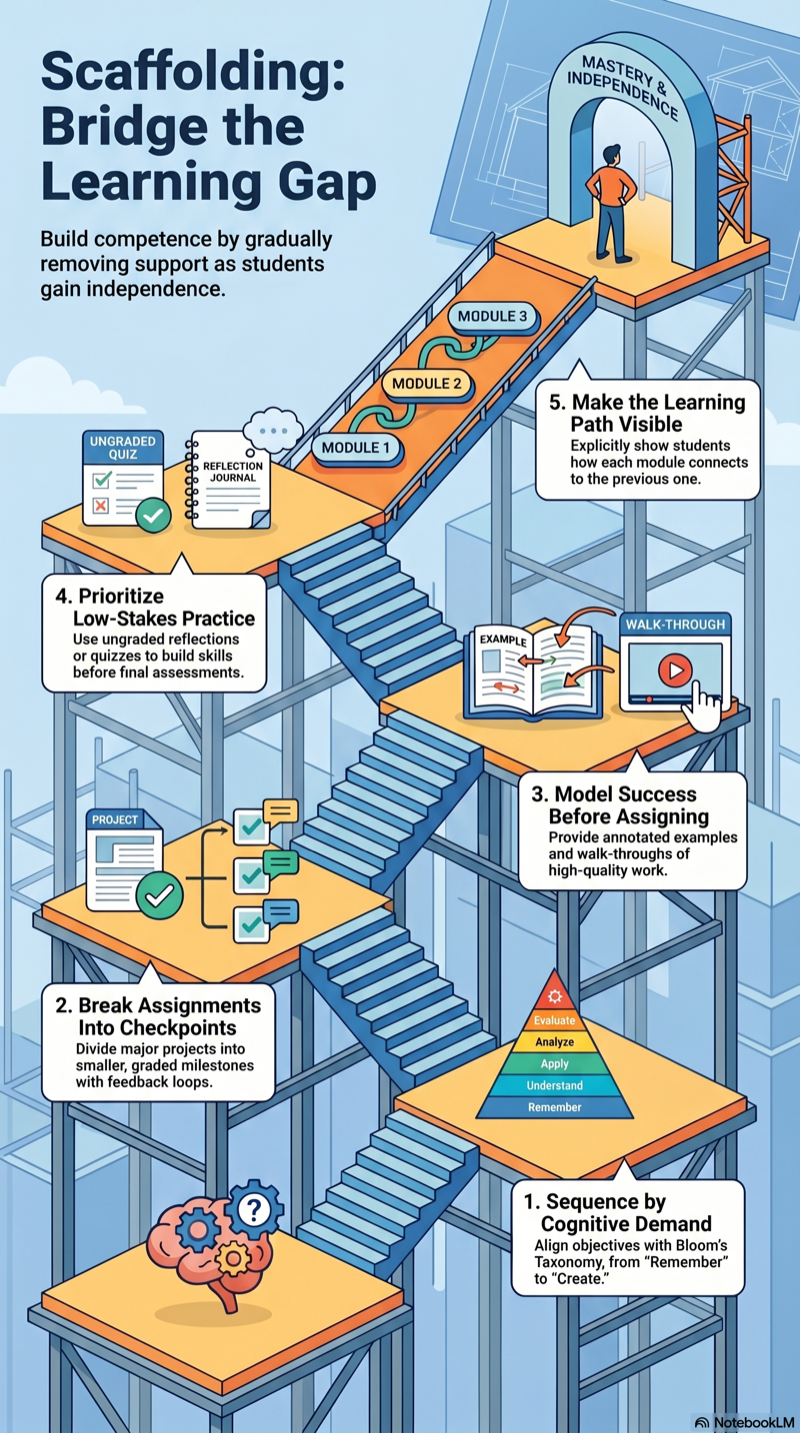
What Scaffolding Actually Means
Scaffolding isn't dumbing things down. It's breaking complex skills into learnable steps and providing temporary support that you gradually remove as students gain competence. The same way construction scaffolding supports a building during construction and comes down when the structure stands on its own.
In practice, this means students don't jump from remembering definitions in Week 1 to writing a critical analysis in Week 8 without guided steps in between. Each module builds on the one before it — and students can see how the pieces connect.
The Problem With Skipping the Scaffold
Most courses aren't scaffolded poorly on purpose. The structure just reflects how experts think — not how novices learn. You understand your discipline as an interconnected web. Your students experience it as a sequence. When the sequence has missing rungs, students fall.
Common symptoms of missing scaffolding:
- Students do well on quizzes but bomb the final paper
- "I don't even know where to start" emails on major assignments
- Strong performance in early modules, sharp dropoff in later ones
- Students who can recall concepts but can't apply them
These aren't motivation problems. They're design problems.
How to Build It In
1. Sequence by Bloom's, Not Just by Topic
Organize your modules so cognitive demand increases progressively. Early modules should focus on remembering and understanding. Middle modules shift to applying and analyzing. Late modules push into evaluating and creating.
This isn't just theory — it's practical. When your learning objectives follow this progression, everything downstream (activities, discussions, assessments) naturally scaffolds.
2. Break Big Assignments Into Checkpoints
Don't assign a research paper in Week 10 and collect it in Week 14. Instead:
- Week 10: Submit a topic and three potential sources
- Week 11: Submit a thesis statement and outline
- Week 12: Submit a rough draft of the introduction and one body section
- Week 14: Submit the final paper
Each checkpoint is a scaffold. Students get feedback at each stage, and you catch problems before they become unsalvageable.
3. Model Before You Assign
Before asking students to do something complex, show them what it looks like. Provide an example of a strong discussion post, walk through how you'd approach a case analysis, or annotate a sample paper showing what earns full marks.
This takes five minutes of class time and prevents fifty confused emails.
4. Use Low-Stakes Practice Before High-Stakes Assessment
Students need space to try, fail, and learn before the grade counts. A weekly ungraded reflection, a practice quiz, or a peer review exercise lets students build the skill before you assess it. Your assessments should measure learning, not punish the learning process.
5. Make the Structure Visible
Students can't use scaffolding they can't see. Tell them explicitly: "Module 3 builds on Module 2. Here's how." Include a brief note at the top of each module connecting it to what came before and what comes next.
A well-built course outline already does this — each module has clear objectives that build progressively, with activities and assessments that match. When students can see the trajectory, they're more likely to stay on it.
Scaffolding Across Modalities
The principle is the same whether you're teaching online, hybrid, or face-to-face. What changes is the delivery:
- Online: Use module sequencing in your LMS so students must complete Module 2 before accessing Module 3. Build in self-check quizzes between modules.
- Hybrid: Use in-person sessions for the guided practice steps and online components for independent application.
- Face-to-face: Use class time for modeling and group practice. Assign independent application as homework.
The Connection to Course Design
Here's the thing about scaffolding: it's not something you add on top of a finished course. It is the course design. A course with clear learning objectives that progress from foundational to advanced, with assessments that build toward capstone work, with modules that connect to each other — that course is scaffolded by default.
The structural work — sequencing objectives, aligning assessments, building progressive module content — is exactly the kind of design that takes weeks to do by hand. It's also exactly the kind of design that AI course tools handle well: generating a progressive structure that you then customize for your students, your discipline, and your teaching style.
CourseDev builds scaffolded course structures — with progressive learning objectives, sequenced modules, and aligned assessments — ready for you to review, revise, and teach. Try it free.