
Faculty who try CourseDev for the first time tend to ask the same question once they open the generated document: how did it produce this much, and how is it this specific to my subject?
It's a fair question. A generated course isn't a loose collection of topic summaries. It's a structured set of modules, each one carrying learning objectives, an overview, discussion prompts, assignments, exercises, talking points, and quizzes. A nursing course reads like a nursing course. A political theory course reads like a political theory course. That specificity isn't an accident, and it isn't magic. It's the result of how the course is scoped before a single word of content gets written.
We won't get into the machinery under the hood. But the thinking behind it is worth sharing, because it explains why the output is as complete as it is.
Scoping Comes Before Content
The reason most generic AI output feels thin is that it skips scoping. Ask a chatbot to "write a module on supply and demand" and it will give you something plausible but rootless. It doesn't know what course this belongs to, who the students are, where this module falls in the sequence, or what came before it.
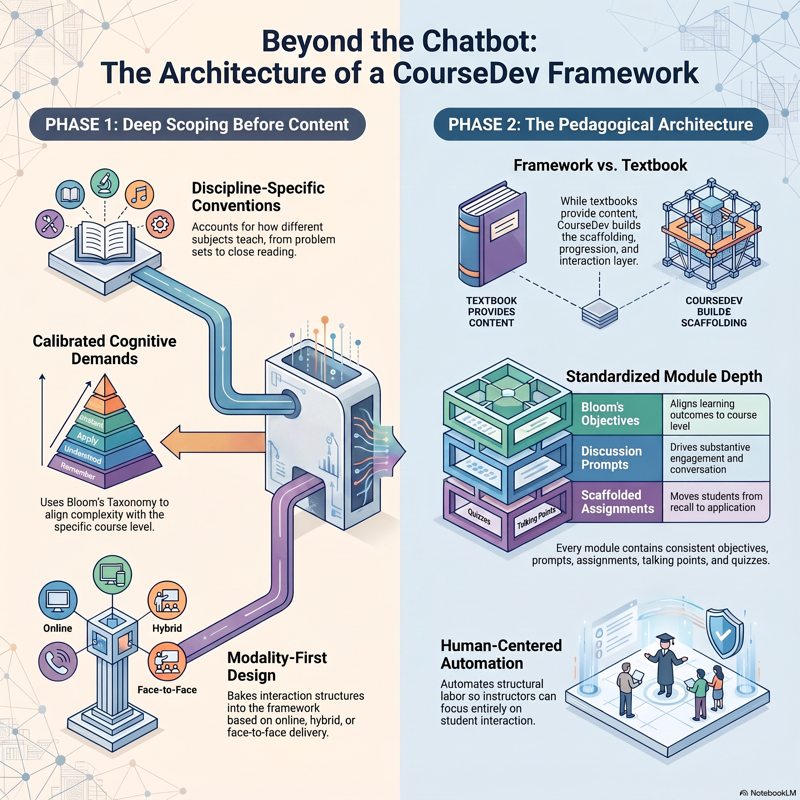
CourseDev starts from the opposite direction. Before generating anything, it establishes the parameters that define the shape of your course:
Subject discipline and its conventions. A statistics course and a literature course don't just cover different content. They think differently. One builds through problem sets and computational practice; the other through close reading and argument. The scoping accounts for how a discipline actually teaches, not just what it covers.
Course level. An introductory survey and an upper-division seminar on the same topic require entirely different cognitive demands. Level determines where on Bloom's Taxonomy each module should sit and how quickly complexity ramps.
Modality. A course built for online delivery needs different interaction structures than one built for a hybrid or face-to-face room. Scoping bakes that in from the start rather than bolting it on later.
Scope and sequence. The number of modules, the progression between them, and the way each one scaffolds onto the last. This is what keeps Module 6 from repeating Module 2 and ensures the course builds toward something.
Once those parameters are set, every module is generated in relation to the whole. That's why the pieces fit together instead of reading like disconnected search results.
The Textbook Covers the Content. This Covers the Course.
A textbook gives your students the foundational reading they need. It explains the theories, walks through the examples, and serves as the reference they return to throughout the semester. That's what textbooks do well, and nothing here changes that.
But a textbook doesn't structure your course. It doesn't decide how your modules should sequence, what cognitive level each week should target, or how an activity in Module 3 should prepare students for the assessment in Module 7. It doesn't design the discussion prompts that turn reading into conversation, or build the exercises that move students from understanding a concept to applying it. That pedagogical layer... the scaffolding, the progression, the interaction design... is work the instructor does on top of the textbook, usually alone, usually under time pressure.
That's the layer CourseDev generates. Not the reading material. The course framework that wraps around it.
Every module is scaffolded so that activities build on each other and students develop skills progressively rather than all at once. Learning objectives drive the structure, and each activity within a module connects back to what students are supposed to demonstrate by the end of it. The discussions push students to engage with ideas at the right cognitive level. The assignments ask them to apply what they've read, not just repeat it. The quizzes check whether the objectives were met.
Your textbook remains the content backbone. CourseDev provides the pedagogical architecture that turns assigned readings into an intentional learning experience, with every module carrying the same structural depth from the first week to the last.
What Each Module Actually Contains
To be concrete, every module in a generated course arrives with:
- Learning objectives written with Bloom's-aligned verbs, matched to the course level
- A module overview that frames the purpose and connects it to the sequence
- Discussion prompts designed for substantive engagement, not word-count filler
- Assignments that ask students to apply and analyze, not just recall
- Exercises for practice and lower-stakes skill-building
- Talking points you can carry straight into lecture or narration
- Quizzes aligned to the module's stated objectives
Same depth, every module, across whatever subject you bring. A welding technology course and a medieval history course come out equally complete, because the scoping adapts to the discipline while the structure stays consistent.
The Human Is Still the Point
Here's the part that matters most, and it's the reason all of this is built the way it is. A complete course package isn't meant to run itself. It's meant to free you to teach.
Every element is designed around human interaction at the center of the classroom. The discussion prompts exist so you can engage with student thinking. The assignments create work for you to respond to. The talking points are scaffolding for your voice in the room, not a script to replace it. The generated course does the structural labor so that your time and energy go where they actually matter: the back-and-forth with students that no tool can generate and no textbook can provide.
That's the philosophy underneath the parameters. You're still driving the course. CourseDev just makes sure you're driving something complete, coherent, and built for the subject you actually teach... instead of spending your summer assembling it one module at a time.
CourseDev generates complete course frameworks scoped to your subject, level, and modality, with objectives, discussions, assignments, exercises, talking points, and quizzes in every module, all in an editable Word document. Comprehensive by design, human at the center. Try it free.