
If you teach online at an accredited college or university, your course has to meet a federal standard that most course design tools have never heard of. It's called Regular and Substantive Interaction, or RSI, and it's not optional. It's a requirement from the U.S. Department of Education.
And yet... the vast majority of course design tools on the market weren't built with RSI in mind. They weren't built for higher education at all.
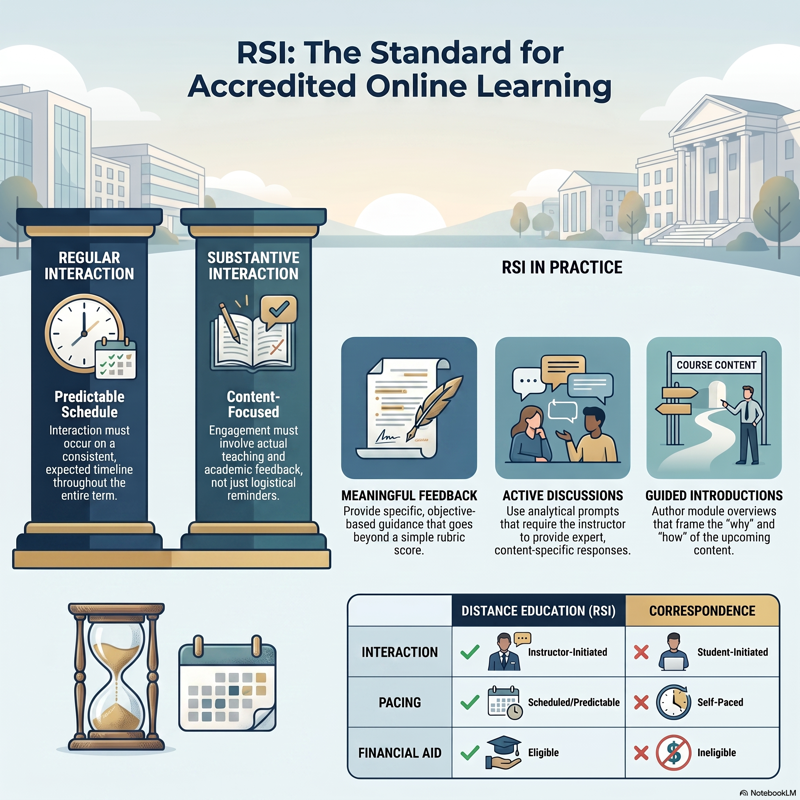
What RSI Actually Is
RSI is the federal standard that distinguishes legitimate distance education from correspondence courses. That distinction matters more than it sounds. A correspondence course is essentially self-paced content with minimal instructor involvement. A distance education course, the kind that qualifies for federal financial aid and counts toward an accredited degree, requires something more: regular, predictable, instructor-initiated interaction that is substantive in nature.
"Regular" means the interaction happens on a predictable schedule throughout the course, not just at the beginning and end. "Substantive" means the instructor is engaging with students about the actual course content, not just sending reminders about due dates or answering logistical questions.
In practical terms, RSI means your online course must include things like:
- Instructor-initiated discussion engagement where you respond to student posts with content-specific feedback, not just "great point"
- Regular, meaningful feedback on assignments that addresses each student's understanding of the material
- Scheduled direct instruction through live sessions, video lectures, or detailed module introductions that guide students through the content
- Ongoing assessment and monitoring of student progress with timely intervention when students fall behind
This isn't a suggestion or a best practice. It's what your accreditor and the Department of Education require for your course to count as distance education.
Why Most Course Design Tools Don't Address This
Here's the part that doesn't get talked about enough. The course design tools most people encounter online... the ones that dominate search results and social media ads... were built for a completely different market. They were designed for corporate training, professional development, and non-degree online courses. Think "learn photography in 30 days" or "master Excel for your team." Valuable content, but no accreditation. No federal oversight. No financial aid. No RSI requirement.
Those tools are optimized for self-paced content delivery. Upload your videos, build your modules, set up a payment page, and let learners work through it on their own schedule. That model works perfectly for what they're designed to do.
But it's the opposite of what federal regulations require for higher education.
When you use a tool built for the corporate training market to design an accredited college course, it doesn't warn you that your course might not meet RSI standards. It doesn't prompt you to build in discussion activities that require instructor participation. It doesn't structure your modules around learning objectives that need to be assessed through substantive interaction. It doesn't know it needs to, because it was never built for that world.
What RSI Compliance Looks Like in Course Design
Meeting RSI isn't about adding a checkbox at the end. It needs to be woven into the design of the course from the beginning. Here's what that looks like at the module level:
Every module needs built-in interaction points. Not just "read this and take a quiz." Students need opportunities to engage with you and with each other about the content. Discussion prompts that require analysis and invite instructor response are one of the most straightforward ways to satisfy this. But the prompts need to be designed so that your response is substantive, not perfunctory. "What do you think about Chapter 5?" won't cut it. A prompt that asks students to take a position, apply a concept, or evaluate a scenario gives you something meaningful to respond to.
Feedback needs to be specific and content-focused. A rubric score alone doesn't meet RSI. Students need to see that you engaged with their work, understood their reasoning, and offered guidance rooted in the course material. This is where intentional course design pays off. When assignments are designed around clear learning objectives, your feedback naturally connects to those objectives. You're not just grading. You're teaching.
Module introductions should do more than list assignments. A brief instructor-authored overview that frames the module's purpose, connects it to the previous module, and previews what students will be working toward gives you a touchpoint for substantive engagement. It also makes your course structure visible to students, which research consistently shows improves outcomes.
Scaffolded progression supports RSI naturally. When modules build on each other and assignments are cumulative, you're creating natural points for instructor intervention. Checking in on a draft, providing mid-project feedback, or responding to a checkpoint submission are all substantive interactions that happen organically in a well-scaffolded course.
The Higher Ed Difference
This is the fundamental distinction that gets lost in the noise of "AI course design tools." There are two very different worlds of online education, and they require very different approaches.
Non-degree online courses operate outside the accreditation system. They can be entirely self-paced, require zero instructor interaction, and deliver content however they want. The tools built for this market are excellent at what they do. But what they do is not what higher education requires.
Accredited degree programs operate under federal oversight. Your online courses must meet RSI. Your hybrid courses must meet different but equally specific standards for seat time and interaction. Your assessments must demonstrate that students achieved measurable learning outcomes. Your institution's accreditation depends on it.
If you're an educator at a college or university, you need course design that was built for your reality. Not adapted from a corporate training platform. Not retrofitted with academic features as an afterthought. Built from the ground up for the standards, regulations, and pedagogical expectations of higher education.
That's the commitment we made when we built CourseDev. Every course framework we generate includes discussion prompts designed for instructor engagement, assessments aligned to measurable objectives, module structures that create natural interaction points, and content delivered in an editable format so you can adapt it to your institution's specific RSI policies. We didn't build a training tool and add academic features later. We built for higher ed from day one.
What You Can Do Right Now
If you're teaching online and haven't reviewed your course for RSI compliance recently, here's a quick self-check:
- Look at each module. Is there at least one activity that requires you to engage with students about the content? Not logistics. Content.
- Review your discussion prompts. Are they designed so your response adds value, or are they so generic that "nice work" is the only honest reply?
- Check your feedback patterns. Are you providing content-specific comments, or mostly rubric scores?
- Examine your module introductions. Do they offer substantive guidance, or just a list of due dates?
- Ask your institution. Your accreditor may have specific RSI documentation requirements. Better to know now than during a review.
RSI isn't going away, and enforcement is getting more rigorous, not less. The good news is that meeting the standard doesn't mean more work. It means better-designed work. A course built around intentional learning, clear objectives, and meaningful interaction points meets RSI almost by default, because RSI and good pedagogy are asking for the same thing.
You're still the one driving the course. RSI just makes sure your students know you're in the room.
CourseDev generates course frameworks built for accredited higher education, with discussion prompts, assessments, and module structures designed around the interaction standards your institution requires. Your course, your standards, fully in your control. Try it free.