
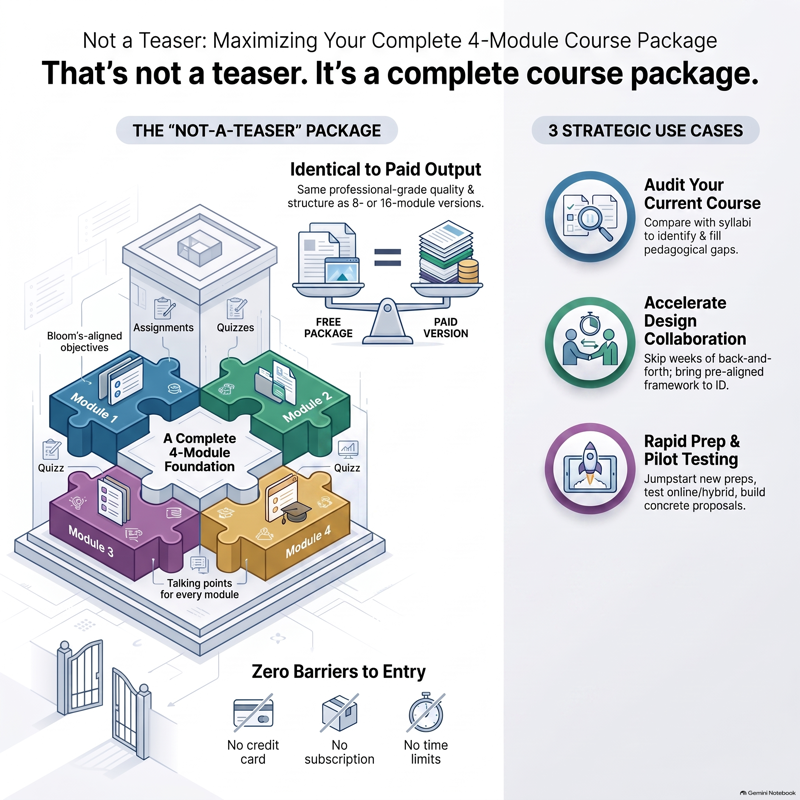
Every CourseDev account comes with one free course. Four modules, fully generated, with learning objectives, overviews, discussion prompts, assignments, exercises, talking points, and quizzes in each one. No credit card. No subscription. No time limit.
That's not a teaser. It's a complete course package, the same output paying users receive, just scoped to four modules instead of eight or sixteen.
But here's the thing. The professors who get the most out of their free course aren't the ones who generate something random just to test the software. They're the ones who come in with a purpose. They use it to solve a real problem... a new prep they're short on time for, a section of their course that's gone stale, or a development process that's taking too long.
Here are five ways to make that free course work for you.
1. Compare It With Your Current Course
This is the single most valuable thing you can do with your free course, and it takes less than an hour.
Generate a four-module course on the same subject you're already teaching. Same level, same modality, similar scope. Then open the Word document side by side with your existing syllabus and materials.
You're not looking for a replacement. You're looking for gaps you didn't know were there. A learning objective that's more precisely measurable than yours. A discussion prompt that pushes students to analyze instead of summarize. An assessment structure that aligns more tightly to the stated objectives. A scaffolding sequence that builds more deliberately across the modules.
After years of teaching the same course, it's hard to see it with fresh eyes. Your course still works, but does it still connect? A generated comparison surfaces the spots where small adjustments could make a meaningful difference. Copy a stronger discussion prompt. Borrow a tighter rubric. Rethink the sequencing of one module. That's not starting over. That's targeted improvement, and it's the fastest path from "my course is fine" to "my course is better."
2. Bring It to Your Instructional Designer
If you're currently developing a course with an instructional designer, your free course can change the entire dynamic of that collaboration.
The traditional workflow goes like this: you draft objectives, your designer reviews for Bloom's alignment, you revise, you submit module outlines, they check the scaffolding, you revise again. Each round is valuable but time-consuming. Weeks of back-and-forth before you even get to the teaching decisions that matter.
Now imagine walking into that first meeting with a CourseDev-generated framework already in hand. The objectives are Bloom's-aligned. The modules scaffold progressively. The discussion prompts connect to specific objectives. The assessments match the stated cognitive levels. The interaction design meets federal requirements.
Your instructional designer can review the framework and jump straight to the higher-value conversation: how you want to teach the material, what discipline-specific adjustments to make, and where your students need something different. The preliminary alignment work that usually consumes weeks? Already done.
Share the Word document with your designer before your next meeting. Ask for their feedback on the structure. You'll likely find that most of the instructional requirements are already met, and the revisions that remain are about fit and preference rather than compliance. That's fewer meetings, shorter timelines, and more of your collaboration spent on the work that actually shapes the course.
3. Get a Head Start on a New Prep
If you've been assigned a new course for the upcoming semester, you know the pressure. Starting from scratch takes months, especially when you're building the framework alongside the content.
Use your free course to generate the first four modules. Enter your subject, level, modality, and a brief course description. What comes back is a scaffolded foundation... objectives, activities, assessments, all aligned... that you can start building on immediately. Even if your full course has eight or twelve modules, having the opening sequence drafted and structurally sound gives you a head start that changes the entire timeline.
This is especially useful for adjuncts picking up a new prep with limited lead time. Four modules of structured content in hand on day one is a fundamentally different starting point than a blank document.
4. Test a Different Modality
You've been teaching your course face-to-face for years and your department wants you to offer it online. Or you're moving to a hybrid format and you're not sure how the interaction design should change.
Use your free course to generate four modules in the new modality. Same subject, same level, but scoped for a different delivery mode. The output will show you how discussion structures, interaction points, and activity designs shift when the modality changes. It's a low-risk way to see what your course might look like in a format you haven't taught before, without committing to a full redesign.
The generated framework gives you a reference for how online or hybrid courses are structured at the activity level, not just the schedule level. That reference alone can save you weeks of trial and error.
5. Build a Pilot for a Course You've Been Proposing
Faculty often have a course idea that never moves past the proposal stage... not because the idea isn't strong, but because nobody has time to build out a full draft for the curriculum committee.
A four-module free course gives you a concrete pilot. Enter your proposed course details and generate a framework that shows what the course would actually look like: how the objectives align, how the modules progress, what kinds of activities and assessments the course would include. That's a much stronger pitch than a one-page course description. It shows the committee you've thought through the pedagogy, not just the topic.
If the proposal gets approved, you've already got a structural draft to build from. If it needs revision, you have something concrete to revise rather than starting over.
One Free Course. Four Modules, Fully Built.
The professors who get the most from it are the ones who bring a purpose. Compare it with your current course and find the gaps worth closing. Share it with your instructional designer and cut weeks off the development cycle. Use it as a head start on a new prep, a modality test, or a course proposal that's been sitting in your head for too long.
You're in control of what comes next. The free course is just the starting point.
CourseDev generates a complete four-module course framework for free, with Bloom's-aligned objectives, discussions, assignments, exercises, talking points, and quizzes in every module. No credit card, no subscription. See what your course could look like. Try it free.