
Let's start with the part nobody wants to hear: if students can paste your prompt into ChatGPT and get a passing grade, the task was already broken.
That's not a defense of cheating. Students who submit AI-generated work as their own are being dishonest, and that matters. But if we stop at "students shouldn't do that," we're treating the symptom while the underlying condition goes untreated. The condition? Coursework that tests recall and production instead of thinking.
The harder, more productive question is: what would your course look like if AI couldn't fake its way through it?
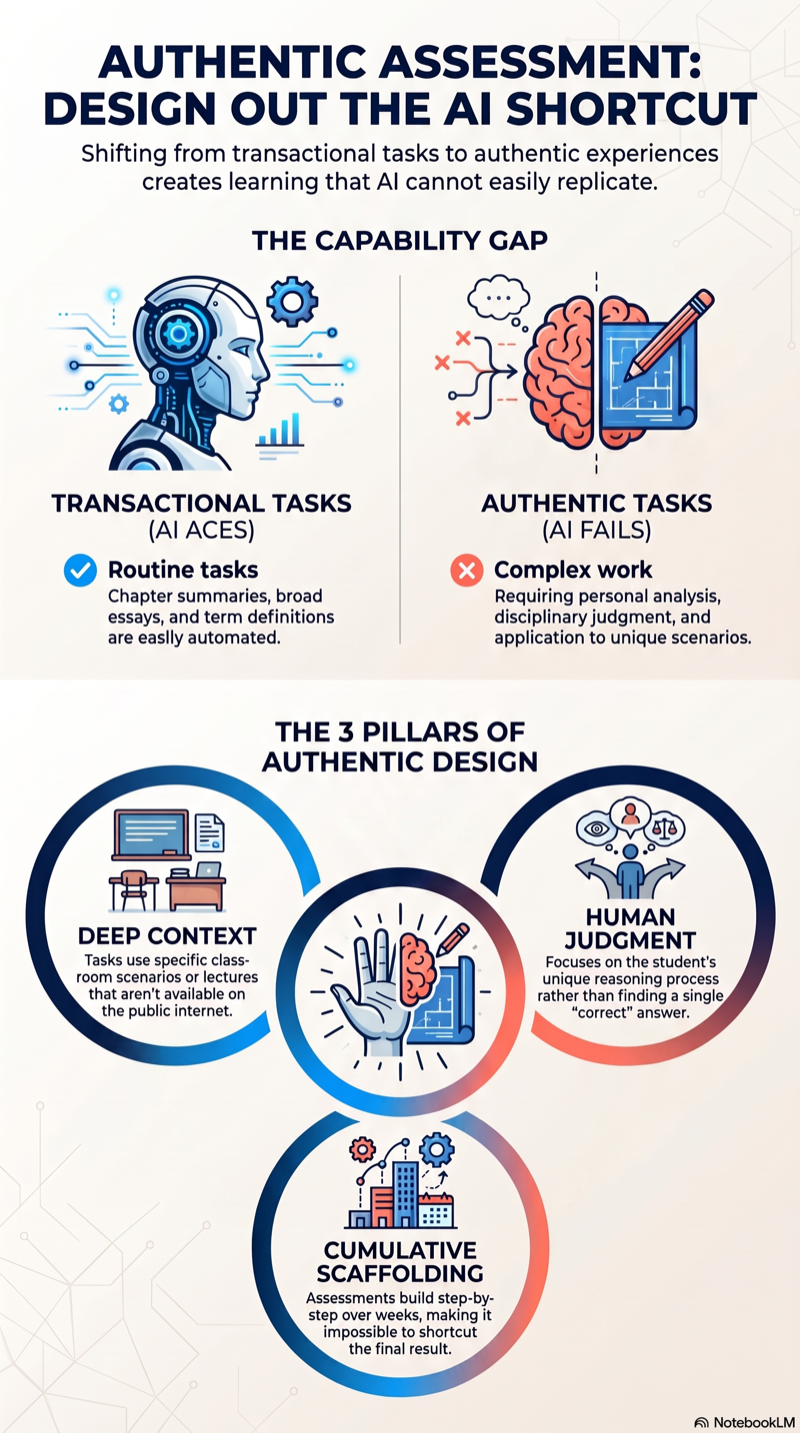
The Tasks AI Aces Are the Ones That Weren't Working Anyway
Think about what AI handles effortlessly: summarize a chapter, define a term, write a five-paragraph essay on a broad topic, post a generic response that hits the word count.
Now ask yourself... were those tasks producing real learning before AI existed? A student who paraphrased the textbook to answer "Discuss the significance of the Industrial Revolution" wasn't demonstrating critical thinking in 2019 either. They were completing a transaction. AI just completes it faster.
The tasks that make students think, the ones that require personal analysis, disciplinary judgment, or application to a specific scenario, are the same tasks AI can't convincingly fake. That's not a coincidence. Higher-order cognitive work has always been harder to shortcut. AI just made the gap between busy work and real work impossible to ignore.
Design the Course, Not the Policy
Most institutions are responding to AI cheating with policy: honor code updates, detection software, stricter proctoring. Those tools have a role. But they're playing defense against a technology that evolves faster than any policy committee can meet.
Course design plays offense.
When your learning objectives target analysis, evaluation, and creation, the coursework that flows from those objectives is naturally harder to outsource. When your modules are scaffolded so that each piece builds on the previous one, a student can't skip to Week 10 and generate the final paper because it depends on work they did in Weeks 3, 6, and 8. When your discussion prompts ask students to respond to a specific classmate's argument or connect the reading to something from Tuesday's lecture, a chatbot can't answer because it wasn't in the room.
These aren't anti-AI tricks. They're just good pedagogy, the kind that instructional designers have recommended for decades. AI didn't create the need for better course design. It just made the cost of skipping it visible.
Authentic Assessment: The Cheat-Proof Framework
There's a name for what we're describing here, and it's been around long before AI entered the conversation: authentic assessment.
Authentic assessment asks students to demonstrate learning through tasks that mirror real-world challenges, not artificial academic exercises. Instead of "write an essay about leadership theories," it's "you're the new department manager facing a team conflict. Using two of the frameworks we studied, write a memo to your supervisor recommending a course of action and explaining your reasoning."
One of those can be pasted into a chatbot. The other requires the student to make choices, apply judgment, and defend those choices in a specific context. That's the difference.
Authentic assessments work against AI cheating because they share three properties:
They're contextual. They reference specific scenarios, case studies, or situations that require knowledge from inside the course, not just knowledge from the internet.
They're judgment-based. There's no single correct answer. The value is in the student's reasoning, not the conclusion. AI can produce a plausible answer, but it can't replicate a student's informed perspective developed over a semester.
They're cumulative. The best authentic assessments build on prior work. A student analyzing a case in Week 12 using the framework they practiced in Weeks 4 and 8 is demonstrating a learning arc that can't be generated from a single prompt.
When you design your course around authentic assessment, you're not adding an anti-cheating layer on top of existing coursework. You're replacing the coursework that was vulnerable in the first place.
The Paradox: AI-Designed Courses That AI Can't Fake
Here's where it gets interesting. The best defense against students misusing AI is a well-designed course. And one of the fastest ways to build a well-designed course is... with AI.
Not AI that writes your students' essays. AI that helps you build the course framework where every task has a clear purpose, every module connects to the next, and every assessment requires the kind of thinking a chatbot can't replicate.
When we build a course structure, the output is grounded in Bloom's-aligned objectives that progress from foundational to advanced. The discussion prompts ask for analysis, not summary. The coursework scaffolds toward complex deliverables that can't be produced by pasting instructions into a chat window. The entire structure is designed around intentional learning, which happens to be exactly the kind of structure that makes AI cheating harder.
You're not fighting AI with AI. You're using AI to do the structural work that produces cheat-resistant courses, then making it your own with the disciplinary expertise, personal examples, and contextual knowledge that only you can bring.
What This Looks Like in Practice
You don't need to redesign everything. A few shifts make a significant difference:
Make coursework cumulative. When the final project depends on a proposal from Week 4, a draft from Week 8, and peer feedback from Week 10, there's no shortcut. Each piece is a checkpoint, and skipping one makes the next impossible.
Require specificity. "Analyze the marketing strategy of a company" is easy to outsource. "Analyze the marketing strategy of the company you've been studying all semester, using the framework we discussed in class, and compare it to the case study from Module 3" is not. Context is the enemy of generic AI output.
Connect online and in-person work. If you're teaching hybrid or face-to-face, reference in-class activities in online tasks and vice versa. Students who weren't present can't fake that continuity.
Assess the process, not just the product. When students submit their thinking at multiple stages... brainstorm, outline, rough draft, revision... the work becomes transparent. AI can produce a polished final product, but it can't convincingly replicate a student's evolving thought process across four weeks.
Tell students why. This is the simplest and most underestimated strategy. When students understand that a task is building a specific skill they'll use in their career, they're more motivated to actually do the work. The transparency that intentional course design provides isn't just good pedagogy. It's a deterrent.
The Real Question
The conversation about AI and academic integrity isn't really about AI. It's about what we're asking students to do and whether those tasks are worth doing honestly.
If the answer is yes, if your coursework genuinely builds skills, challenges thinking, and prepares students for the real world, then most students will do the work. Not all of them. But most. And the ones who don't will struggle in ways that become obvious quickly, because scaffolded courses don't let you fake your way through eight connected modules.
If the answer is no... if the tasks are routine enough that AI can handle them... then the problem isn't the students or the technology. It's a course design opportunity waiting to be seized.
You're still in the driver's seat. AI didn't change that. It just raised the standard for what the ride needs to look like.
CourseDev generates course frameworks with Bloom's-aligned objectives, scaffolded modules, and authentic assessments designed around real-world thinking, not tasks a chatbot can shortcut. Your expertise makes it a course. Try it free.