
Most students aren't lazy. They're just optimizing for what they think the course rewards.
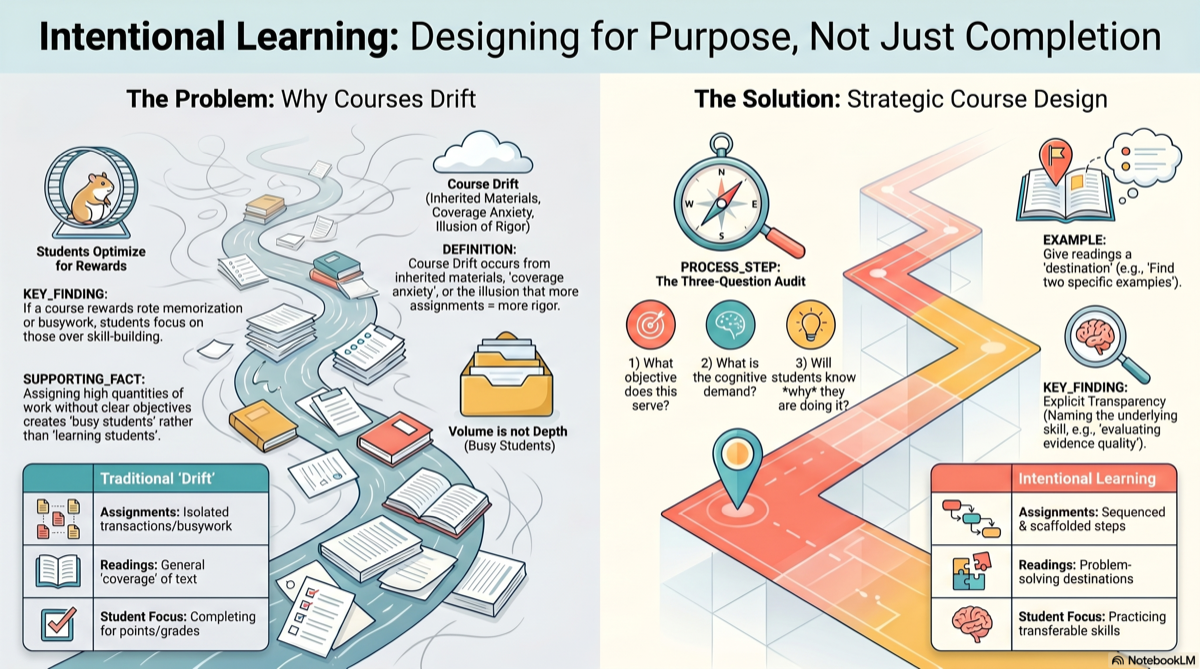
If your course rewards reading the syllabus, they'll read the syllabus. If it rewards memorizing slide decks the night before the exam, they'll memorize the slide decks. If it rewards typing 250 words on a discussion board to hit the participation requirement, that's exactly what you'll get.
The question isn't whether your students are working hard. It's whether the work you're asking them to do is actually building the skills you want them to leave with.
That's the gap intentional learning is trying to close.
What Intentional Learning Actually Means
Intentional learning means designing every part of your course — readings, activities, discussions, assignments, assessments — so that students know why they're doing it and what skill it's building. Nothing is busywork. Nothing is filler. Every task connects to a learning objective that matters.
For students, intentional learning shows up as the ability to answer the question, "Why am I doing this?" If the only answer is "because it's worth 10% of my grade," you've got a design problem.
Why Most Courses Drift Toward Unintentional Learning
Course drift happens for understandable reasons:
- Inherited materials. You took over the course from a colleague, kept their assignments, and never had time to question whether they still serve your objectives.
- Module fatigue. By Module 6, you're tired and you assign "discussion post + quiz + reading" because it's what you assigned in Module 5.
- Coverage anxiety. You feel pressure to "get through" the textbook, so you assign every chapter — whether or not students need every chapter to meet your learning objectives.
- The illusion of rigor. More assignments feel rigorous. But volume isn't depth, and busy students aren't the same as learning students.
None of these are character failures. They're design defaults that creep in when course building happens in fragments.
The Three Questions That Make Learning Intentional
Before you assign anything in your course, run it through three questions:
1. What learning objective does this serve?
If you can't name a specific course learning objective the task supports, cut it or redesign it. Every reading, every discussion prompt, every quiz should map to something you said students would learn.
2. What cognitive demand does it require?
Be honest. Are you asking students to recall, apply, analyze, evaluate, or create? Match the demand to where students are in the course. Foundational content needs lower-level tasks. Capstone work needs higher-level tasks. A discussion prompt that asks students to "summarize Chapter 4" in Week 12 is unintentional — the cognitive level doesn't match where they should be.
3. Will students know why they're doing it?
Tell them. Explicitly. At the top of every module, briefly state what students will learn and how each activity helps them get there. This sounds basic, but most students go through entire courses with no idea why they're being asked to do what they're being asked to do.
What Intentional Learning Looks Like in Practice
Replace "Read Chapter 5" With a Reading Purpose
Don't just assign the reading. Give students a question to answer or a problem to solve as they read. "Read Chapter 5 and identify two examples of [concept]. Be prepared to discuss in class which example better demonstrates [criterion]." Now the reading has a destination.
Connect Each Assignment to the One Before It
Sequence assignments so each one builds on the previous. This is also what scaffolding does. When students see Assignment 3 as the next step after Assignment 2, they engage differently. When each assignment feels random, they treat it as a transaction.
Tell Students What Skill They're Practicing
Before students start an assignment, name the underlying skill explicitly: "This assignment is practice in evaluating evidence quality. That's a skill you'll use in your capstone, your career, and in any decision you make based on data." Students engage more with tasks when they understand the transferable skill.
Build Reflection Into the Course
Intentional learning requires students to think about their own thinking. A two-minute reflection at the end of each module — "What's the most important thing you learned this week? What's still unclear?" — develops metacognition. Students who can name what they learned are more likely to retain it.
Intentional Learning Across Modalities
The principles are the same whether you're teaching online, hybrid, or face-to-face. What changes is the delivery.
In an online course, intentionality often means tighter copy at the top of each module — students can't ask "why are we doing this?" in real time, so the answer needs to be visible. In a face-to-face course, intentionality is built into how you frame each class session: "Today we're working on X because last week you learned Y, and next week you'll need Z."
For community college faculty and adjuncts juggling multiple preps, intentional learning is also a time-saving strategy. When every assignment has a clear purpose, you can cut the ones that don't — and your feedback workload drops with the assignment load.
The Connection to Course Design
Here's the practical reality: intentional learning isn't a teaching technique you add on top of a finished course. It's a course design property. A well-designed course — where learning objectives drive the outline, where modules build on each other, where every assessment maps back to an objective — is intentional by construction.
The work of building that kind of course is real. Sequencing objectives, aligning assessments, designing module content that progresses purposefully — it takes weeks to do by hand and creates exactly the kind of structural alignment that intentional learning requires. AI-assisted course design tools handle the structural work efficiently, giving you a foundation where alignment is built in. Your job is then to add the discipline expertise, the contextual examples, and the framing that makes the course yours — which is the high-value work anyway.
Stop Optimizing for Completion
The students sitting in your course aren't broken. They're responding rationally to the signals your course is sending. If you want them to think harder, design a course where thinking harder is the path to success. If you want them to engage deeply, build assignments where deep engagement is what gets rewarded.
Intentional courses produce intentional students. That's the whole game.
CourseDev builds aligned course structures — where learning objectives, module content, and assessments all connect — so every activity has a purpose students can see. Try it free.