You built your course years ago, and it's a good course. The theories are sound. The structure holds up. Students pass, and many of them learn exactly what they're supposed to learn.
So this isn't a conversation about whether your course works. It does. This is a gentler question: does it still connect — to the industries your students are entering, to the problems they'll face on day one, and to the way the world has shifted since the last time you rewrote your syllabus from scratch?
That's not a criticism. It's a reality every educator eventually faces, regardless of discipline.
The Foundations Are Fine. The Edges Might Not Be.
The core theories in your field haven't changed. Supply and demand still works. Maslow's hierarchy still explains motivation. The scientific method is still the scientific method. Nobody is suggesting you throw out your foundations.
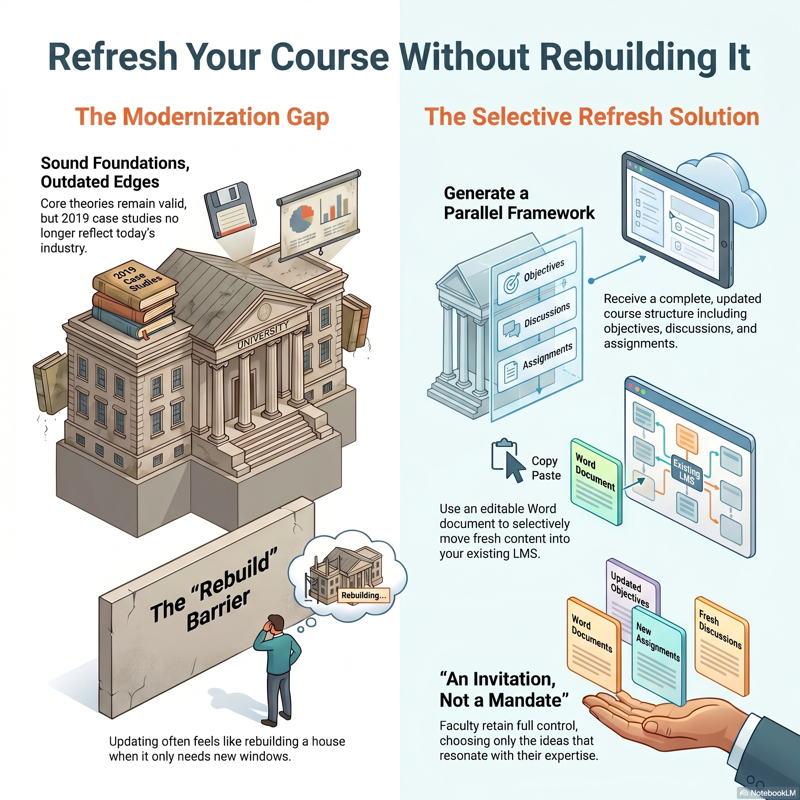
But the applications surrounding those foundations move faster than any syllabus can keep up with. The case studies from 2019 may no longer reflect the industries your students will enter. The career skills you emphasized five years ago may have shifted. The examples that once felt current might now feel like history to a twenty-year-old sitting in your classroom.
This isn't about chasing trends. It's about making sure your course still speaks to the world your students are preparing for — whether they're online, in your classroom, or somewhere in between.
Why Updating Feels Like Starting Over (And Why It Doesn't Have to)
Here's the real barrier. It's not that you don't know your course could use a refresh. It's that refreshing a course you've taught for years feels like rebuilding a house when all it needs is new windows.
You don't want to tear down your module structure. You don't want to rewrite every discussion prompt and every assignment. You just want to look at your materials with fresh eyes — and maybe borrow a few ideas that bring the content closer to 2026.
That's a very different task from building a new course. And it deserves a very different tool.
A Second Opinion, Not a Second-Guess
Imagine generating a parallel version of your course — same subject, same level, same number of modules — but with updated learning objectives, contemporary examples, and fresh assessment approaches. Not to replace what you've built. Just to lay it alongside your existing materials and see what catches your eye.
That's what CourseDev does. It produces a complete course framework — objectives, module content, discussions, assignments, exercises, and talking points — and delivers it as an editable Word document. Not a platform. Not an LMS package. A document.
Why Word? Because a document respects the way experienced faculty actually work. You open it next to your existing syllabus. You scan a module. You find a discussion prompt that frames a concept better than the one you've been using. You copy it, paste it into your slides or LMS, and adjust it to fit your voice. Three minutes. One small upgrade. Your course just got a little more current.
You're not starting over. You're selectively refreshing — on your terms, at your pace.
The Copy-and-Paste Advantage
This is worth emphasizing because it's the part that matters most to faculty who aren't looking for a wholesale change.
You don't have to adopt anything. You don't have to import anything. You don't have to learn a new platform. You read through a generated course document, and if something resonates — a scaffolding sequence that builds better than your current one, an exercise that pushes students to think more intentionally, an assessment rubric that's tighter — you copy it and paste it into whatever you already use.
The rest you ignore. No pressure. No commitment. Just a well-organized reference document sitting on your desktop whenever you're ready to look at it.
An Invitation, Not a Mandate
If you've been teaching your course for years and it works, nobody should tell you to tear it up. Certainly not an AI tool.
But if you've had a quiet thought — maybe during finals week, maybe over summer break — that some of your materials could use a fresh perspective? That the world your students are entering has shifted in ways your syllabus hasn't caught up with yet?
CourseDev is built for exactly that moment. It's not here to replace your expertise. It's here to offer a second set of eyes — one that's current, well-structured, and entirely under your control.
Just a chance to see your course through a slightly different lens. You might find nothing worth changing. Or you might find one idea that makes your next semester a little stronger.
Either way, the decision is yours. It always should be.
CourseDev generates a complete course framework — learning objectives, module content, discussions, assignments, and assessments — delivered as an editable Word document. Keep what resonates, skip what doesn't. Your course, your call. Try it free.