
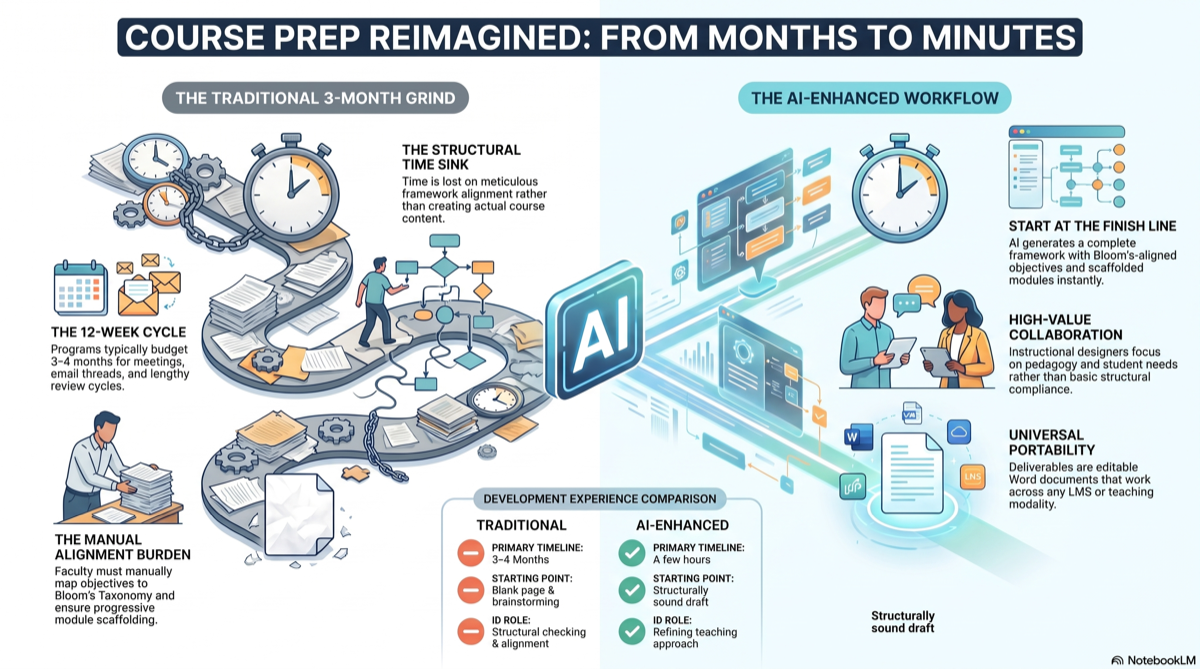
If you've ever developed a new course at a college or university, you know the timeline. Three months is typical. Some programs budget four. And that's not three months of writing content. That's three months of meetings, revisions, email threads, and a review cycle that somehow always takes longer than anyone expected.
The process usually looks something like this: you sit down with an instructional designer. You discuss your course goals. You draft learning objectives. The designer reviews them for Bloom's alignment. You revise. You submit module outlines. The designer checks the scaffolding. You revise again. You write discussion prompts. The designer flags that they don't align with the module objectives. You revise once more.
Each round is valuable. Instructional design standards exist for good reason. But the back-and-forth takes weeks, and the faculty member does most of the heavy lifting while also teaching, grading, advising, and serving on committees.
With fall approaching, here's a question worth asking: what if you could start that process with the hardest part already done?
Where the Time Actually Goes
Most faculty assume the time sink in course development is the content itself. It's not. The content is the part you know. You've been teaching this material for years. The ideas are in your head.
The time goes to the framework. Aligning learning objectives to Bloom's Taxonomy at both the course level (CLOs) and module level (MLOs). Structuring modules so they scaffold progressively. Making sure discussion prompts connect to specific objectives. Ensuring assessments measure what the objectives promise. Building in interaction points that satisfy federal requirements for online delivery.
This is the structural work that instructional designers spend weeks helping you get right. Not because it's conceptually difficult, but because it's meticulous. Every piece has to align with every other piece. Miss one connection and the whole structure drifts.
It's also the work that AI handles exceptionally well.
Start With a Draft That's Already Built Right
When you generate a course through CourseDev, what you get back isn't a rough brainstorm or a collection of AI-generated paragraphs. It's a complete course framework where the instructional design work is already done.
The learning objectives are written with Bloom's-aligned action verbs, one per objective, at appropriate cognitive levels. The course-level objectives (CLOs) connect to module-level objectives (MLOs), and those MLOs drive everything downstream. The module content scaffolds from foundational concepts to higher-order application. The discussion prompts are designed for substantive engagement, not filler. The assessments align to the stated objectives. The activities match the cognitive level each module targets.
In other words, the draft already meets the instructional design standards your institution requires. You're not starting from scratch and iterating toward compliance over twelve weeks. You're starting from a structurally sound framework and refining it toward your specific course vision.
That's a fundamentally different starting point, and it changes the entire development timeline.
What This Means for the Instructional Design Process
This doesn't replace your instructional designer. It changes when they become most useful.
In the traditional workflow, a significant portion of your time with an instructional designer is spent on preliminary alignment work. Are the objectives measurable? Do the activities match the cognitive level? Is the scaffolding progressive? These are important questions, but they're structural questions. They're about whether the framework is sound before you even get to the content that makes your course yours.
When you bring a CourseDev-generated framework to that first meeting, the preliminary work is already addressed. The objectives are aligned. The scaffolding is in place. The structure meets instructional design guidelines. Your instructional designer can look at it and say, "the framework is solid, now let's talk about how you want to teach this."
That conversation... the one about your teaching approach, your discipline-specific examples, your students' needs... is where the real value of instructional design collaboration lives. And it's the conversation that usually gets compressed into the final weeks because so much time was spent on structural revisions.
One Document. Every Modality. No Platform Lock-In.
Everything CourseDev generates is delivered as an editable Word document. Not a platform. Not an LMS package. Not a format that locks you into a specific tool.
This matters because the same fundamental principle applies whether you're teaching online, hybrid, or face-to-face. Good course design is good course design. Aligned objectives, scaffolded modules, intentional activities, and meaningful assessments work in every modality. What changes is the delivery, not the structure.
A Word document lets you work the way experienced faculty actually work. You open it next to your existing materials. You scan a module. You find a discussion prompt that frames a concept better than what you had. You copy it, paste it into your LMS, your slide deck, or your lecture notes, and adjust it to fit your voice. You find an assessment rubric that's tighter than yours. You borrow the structure and customize the criteria.
What doesn't fit? You skip it. No uninstalling. No undoing an import. You just don't copy that part. You keep what works and leave what doesn't, and the course that comes out of it is entirely yours.
You're in the Driver's Seat. The Framework Just Gets You on the Road Faster.
Here's what this comes down to. The expertise that makes your course valuable... your disciplinary knowledge, your teaching instincts, the way you read a room or adjust an assignment mid-semester because you can see students aren't getting it... none of that can be generated by AI. That's still yours.
What can be generated is the structural foundation that takes weeks to build by hand. The Bloom's-aligned objectives. The scaffolded module progression. The discussion prompts that require authentic engagement. The assessment alignment. The framework that instructional design guidelines require and that typically eats up months of your summer.
CourseDev handles that structural work so you can focus on the work that actually requires you. Not because the framework doesn't matter, but because getting it right shouldn't take three months when the technology exists to get it right in a few hours.
Fall is coming. Your course prep doesn't have to take all summer.
CourseDev generates complete course frameworks, with Bloom's-aligned objectives, scaffolded modules, discussion prompts, assessments, and talking points, all delivered as an editable Word document that works across any LMS and any modality. Start with the hard part done. Try it free.