
Let's start with something that stopped being controversial about two years ago: AI is now a baseline tool for course prep. Not a curiosity, not a threat, not a conference keynote topic. A baseline. Most faculty we talk to have already used it to draft an objective, tighten a rubric, or rescue a discussion prompt at 11pm on a Sunday.
That's good. It's the right instinct. AI genuinely saves time on the right tasks.
But here's the question worth asking out loud: if AI is supposed to make course prep faster, why does building a course with AI still take a full weekend?
Era One: By Hand
You know this one because you lived it.
Blank document. Your textbook's table of contents. A syllabus a colleague emailed you in 2019. Forty browser tabs. You wrote the objectives yourself, sequenced the modules by instinct, and drafted every discussion question from scratch. If your institution had an instructional designer, you got three months of revision cycles. If it didn't, you got your best guess.
It worked. It also took months, and the framework part, not the content part, ate most of it.
Era Two: The Prompt Discovery
Then chatbots arrived, and faculty did what smart people do with a new tool. They poked at it.
"Write a module overview on cellular respiration." And something appeared. Reasonable prose, decent structure, generated in nine seconds. For about a week, it felt like the problem was solved.
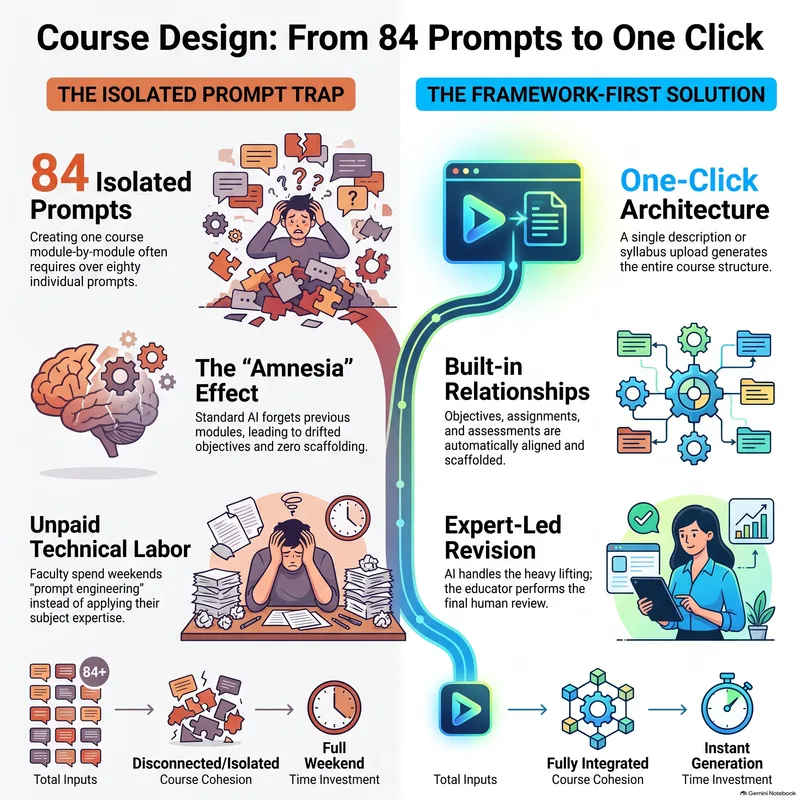
Then you asked for Module 3 and noticed it had no idea Module 2 existed. The objectives drifted. The assignment in Module 5 assumed a skill you'd never taught. The discussion prompts were all interchangeable, because each one had been written by a system with total amnesia about everything before it.
Not bad content. Just twelve unrelated pieces of content wearing the same font.
Era Three: Where Most Faculty Are Right Now
Prompt skills have improved a lot. Departments share prompt libraries. People know to specify level, modality, cognitive demand, output format. The individual results are noticeably better than 2023.
And the workflow is exactly the same.
Prompt. Read. Revise. Prompt again. Then again for the next section, and again for the next module. Seven sections times twelve modules is eighty-four prompts, each one needing you to remember what the last eighty-three produced so the course doesn't contradict itself. There's no shortcut through it. It's sequential by design, and you are the only thing holding the sequence together.
Better ingredients. Still no architecture.
The Actual Problem Isn't Prompt Quality
This is the part that gets missed. The weakness of prompt-by-prompt generation isn't that any single answer is bad. It's that the things which make a course a course are not properties of individual pieces. They're relationships between pieces.
Scaffolding is a relationship. Module 7 has to assume what Module 4 built.
Alignment is a relationship. The assessment has to measure the objective it sits under, not something adjacent to it.
Progressive cognitive demand is a relationship across the whole sequence, not a setting you apply to one module.
A single prompt has no relationships. It has one request and one response. So you can write eighty-four excellent prompts and still end up with a course that doesn't hold together... because the structure was never anyone's job. It was assumed to emerge. It doesn't.
Why a System Beats Prompt-and-Go
The alternative isn't a better prompt. It's a framework that runs before any content gets written.
CourseDev decides the shape first: discipline, level, modality, module count, and how the cognitive demand should climb from the first module to the last. Only then does generation start, and every section is written in relation to that structure rather than in isolation.
Course objectives drive module objectives. Module objectives drive the overview, the discussion prompts, the exercises, the assignments, and the assessment. Talking points are calibrated to the level you're teaching and the modality you're teaching in, because a seminar talking point and an asynchronous one are not the same object.
That's a single complicated prompt architecture doing what eighty-four simple ones structurally cannot. Alignment isn't checked afterward. It's a precondition.
One Click, and Why That Number Matters
What you provide: a short course description. Or your existing syllabus, uploaded.
That's the input. Not a prompt library. Not an afternoon of iteration. Not a skill you have to acquire on top of the four other things you're already doing this month.
And this is the philosophical part, so let's be direct about it. The reason you reached for AI was efficiency. You wanted the technology to absorb the tedious, meticulous, rule-bound work so you could spend your hours on the parts that require you. If the tool instead requires you to become fluent in prompting before it performs, the burden moved. It didn't disappear.
The framework should be as comprehensive as possible so the input can be as simple as possible. Not the other way around.
Your Expertise Isn't Prompt Engineering
You were hired because you know your field. You're the one who decides what students should be able to do when they walk out of your classroom, which concepts are non-negotiable, where your students historically get stuck, and what "good enough" actually means in your discipline.
Those are irreplaceable judgments, and they're yours.
Writing prompt number fifty-two so an AI will finally produce a rubric that matches your objective? That is not subject expertise. That's unpaid technical labor, and asking a chemist to do it because the tool wasn't built well enough is a strange way to run a profession.
You're a subject expert. The framework should handle being the instructional design expert.
CourseDev generates a complete course framework from one short description or an uploaded syllabus, with Bloom's-aligned objectives, scaffolded modules, discussions, assignments, exercises, assessments, and talking points already connected to each other. Delivered as an editable Word document, so every decision still runs through you. Try it free.