
You walk into a classroom, lecture, lead discussions, grade papers, hold office hours. You've been doing it for years and your students learn. You don't use Canvas or Blackboard. You don't work with an instructional designer. You may not think about "course design" as a formal discipline because, honestly, nobody ever taught you to.
And that's not your fault. Most universities hire brilliant subject experts and hand them a classroom with almost no training in how to structure a course. You learned by doing, through trial, error, and a decade of reading the room.
So when you hear about an AI tool that generates "course content," your first reaction is probably: that's for online people.
It's not. And the faculty who've tried it for face-to-face courses are often the most surprised by what they find.
You Shouldn't Have to Learn Instructional Design Theory to Teach Well
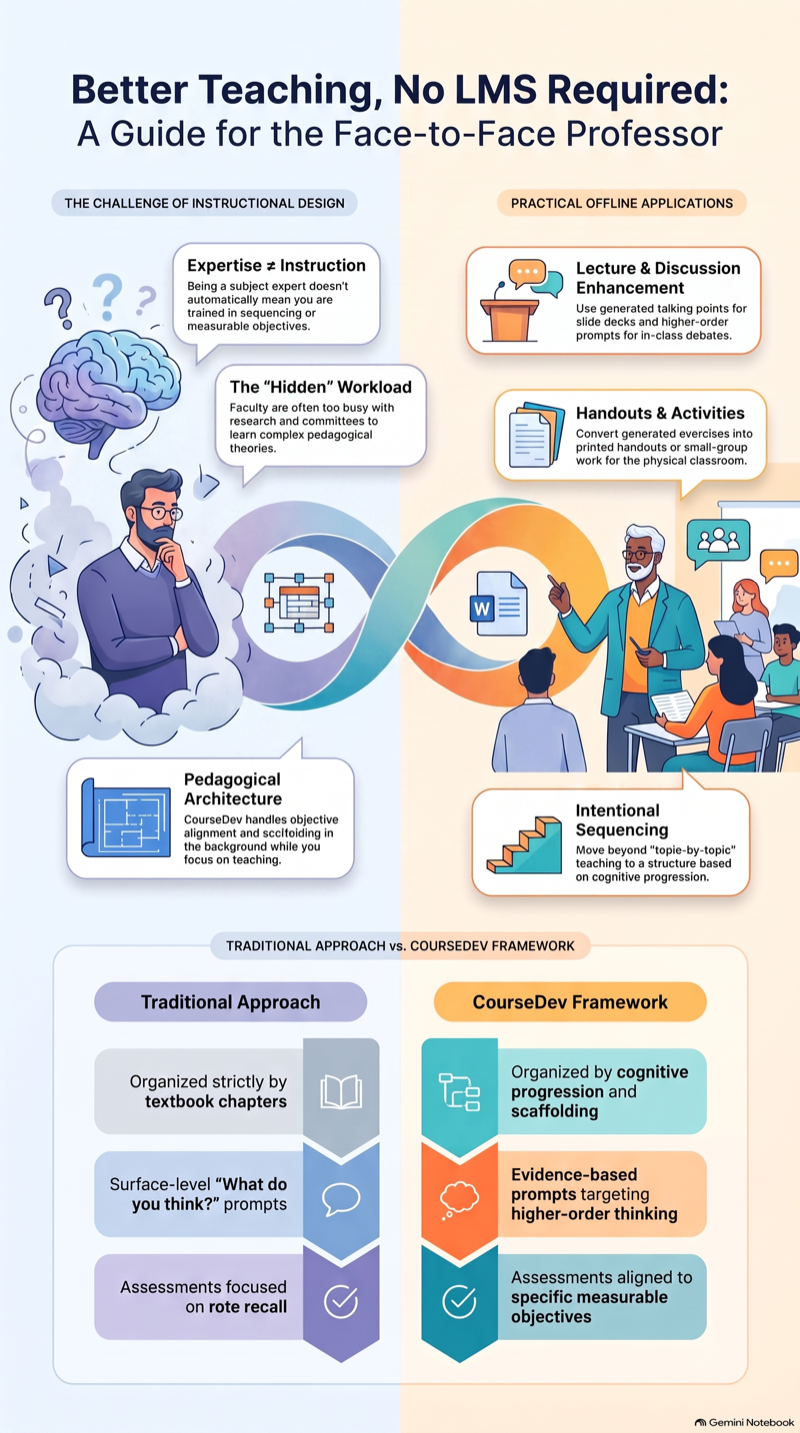
Here's something that rarely gets said out loud: being an expert in your subject doesn't automatically make you an expert in teaching it. How to sequence a course so skills build progressively? How to write learning objectives that are actually measurable? How to design assignments that push students past memorization into analysis? That's instructional design, and most faculty never received formal training in it.
But let's be realistic. You're already teaching multiple sections, writing grant proposals, supervising students, serving on committees, and trying to stay current in your research. Learning Bloom's Taxonomy, backward design models, and constructive alignment on top of all that? It's not realistic, and it shouldn't have to be.
CourseDev handles the pedagogical architecture so you don't have to become an instructional design expert. The objectives are aligned to the right cognitive levels. The scaffolding is built into the module sequence. The assessments map back to what students are supposed to demonstrate. The discussion prompts target higher-order thinking. You don't have to know why it's structured that way for it to work. You just teach from it, and the pedagogical standards are met in the background. Your time stays where it belongs... on your research, your students, and the subject expertise that got you hired.
How Face-to-Face Professors Actually Use the Package
The generated course arrives as a Word document. That's intentional, because face-to-face teaching doesn't live inside an LMS. It lives in your lecture notes, your printed handouts, your slide decks, and the talking points you carry into the room.
Pull talking points into your lecture prep. Open the document on one side of your screen, your slides on the other. Every module includes structured talking points that keep your lecture focused and intentionally sequenced. You're not reading a script. You're working from a well-organized set of ideas.
Run better class discussions. You don't need a discussion board to use a good discussion prompt. Print three prompts, hand them out for small-group work, or project one on screen to launch a whole-class debate. The prompts push students beyond surface-level responses, so your conversations get more substantive without you having to improvise.
Turn exercises into handouts and in-class activities. Each module includes practice exercises matched to the cognitive level that module targets. Print them, adapt them, or use them as inspiration for group work.
Borrow assessment structures. The quizzes and assignments are aligned to specific objectives. Even if you don't use them directly, they show you what well-aligned assessment looks like... especially useful if you want a fresh perspective on how to test for thinking rather than recall.
What Faculty Are Saying
A biology professor who'd been teaching the same introductory course for eleven years generated a four-module version through CourseDev. Their response: "The scaffolding between modules was something I'd never thought about deliberately. I always organized by topic, chapter by chapter. Seeing the same content organized by cognitive progression... I realized my students were hitting the hardest concepts in Week 3 with no preparation for that level of thinking."
They didn't adopt the generated course wholesale. They reorganized three modules in their existing course, moved one assignment earlier in the sequence, and added two scaffolded exercises they'd never considered. Their comment afterward: "I kept asking myself, why didn't I think of this sooner? But honestly, nobody ever showed me what intentional sequencing looks like. I just taught the way the textbook was ordered."
A political science professor had a similar experience with discussion design: "I've been asking students 'What do you think about this topic?' for fifteen years. The generated prompts asked students to take a position, defend it with evidence from the reading, and then respond to a counterargument. Same material, completely different conversation in the classroom. It wasn't that I couldn't write better prompts. It's that I didn't know what a well-designed prompt was supposed to do."
Try It With What You're Teaching Right Now
If you're a face-to-face professor who's never worked with course design tools, your free course is the simplest way to see what this looks like for your subject.
Generate four modules of the course you're currently teaching. Open the Word document. Read through the talking points, the discussion prompts, the exercises. Compare them with what you're doing now. You might find your course is already strong and the framework confirms it. Or you might find one module where the scaffolding could be tighter, one prompt that would transform your Tuesday seminar, one assessment approach you'd never considered.
No LMS to learn. No platform to navigate. No instructional design theory to study. Just a Word document on your desktop, built for the subject you already know better than anyone. Your expertise drives the course. The framework just makes sure the structure underneath it is sound.
CourseDev generates complete course frameworks delivered as an editable Word document, with learning objectives, module content, discussions, assignments, exercises, talking points, and quizzes. No LMS required. No instructional design background needed. Just your subject expertise and a better-structured course. Try it free.