
Every conference keynote says AI is transforming education. Every skeptic says it's just autocomplete with better marketing. And every faculty member caught in the middle is asking the same question: does any of this actually help students learn?
It's a fair question. And it deserves a more honest answer than either side usually gives.
The Case For: Where AI Genuinely Helps
Better Course Structure Leads to Better Outcomes
The strongest evidence for AI in education isn't about the AI itself — it's about what AI makes possible. Well-structured courses with aligned learning objectives, scaffolded progression, and purposeful assessments consistently produce better student outcomes. That's not an AI finding — it's decades of instructional design research.
What AI does is make that structure accessible to more faculty. An adjunct with two weeks of prep time and three course sections can now build a course with the structural rigor that previously required a team of instructional designers. The student benefit isn't "AI taught them better." It's "their course was better designed because the instructor had the tools to design it well."
Faster Feedback Loops
Students learn more when they get timely, specific feedback. That's one of the most replicated findings in education research. AI tools that help faculty generate rubrics, draft feedback templates, and identify patterns in student work can shrink the feedback cycle — which directly benefits learning.
The key word is "help." AI-assisted feedback where the instructor reviews and personalizes the output works. Fully automated feedback with no human judgment tends to produce generic responses that students ignore.
More Time for High-Value Teaching
When AI handles the structural work — drafting outlines, generating discussion prompts, building assessment items — faculty get time back. The question is whether that time gets redirected toward students.
When it does — more office hours, more individualized feedback, more responsive course adjustments — students benefit measurably. When the time savings just means larger class sizes or more sections, the benefit evaporates.
Consistency Across Sections
Large programs with multiple sections of the same course often struggle with inconsistency — different instructors, different materials, wildly different student experiences. AI-generated base materials give every section a consistent foundation while still allowing individual instructors to customize. Students get a more equitable experience regardless of which section they're enrolled in.
The Case Against: Where AI Falls Short
The Personalization Gap
AI doesn't know your students. It doesn't know that your Tuesday/Thursday section has mostly working parents who can't attend synchronous sessions, or that your intro section has students reading at three different levels. The "personalized learning" promise of AI is, at best, premature. Real personalization requires the kind of contextual knowledge that only comes from being in the room — or reading discussion posts at midnight and noticing who's struggling.
Faculty at community colleges know this especially well. Their student populations are diverse in ways that no model can fully account for. AI-generated content is a starting point, not a finished product — and treating it as finished is where student learning suffers.
The Passive Consumption Risk
There's a real danger that AI makes it easier to create more content — and more content isn't what students need. Students need fewer, more intentional activities at the right cognitive level. If AI makes it easy to generate 15 discussion prompts per module, and an instructor assigns all 15, the tool made the course worse, not better.
The problem isn't the tool. It's the assumption that more is better. AI should help faculty curate, not just produce.
Over-Reliance and Deskilling
If faculty stop thinking critically about course design because "the AI handles it," the quality of courses degrades over time. A generated course outline that nobody reviews becomes a structurally sound but contextually wrong course. A rubric that nobody customizes becomes generic assessment that doesn't match what was actually taught.
The revision step is where teaching lives. Skip it, and you've got efficiently produced mediocrity.
The Equity Question
Not all faculty have equal access to AI tools. Adjuncts at under-resourced institutions may not have institutional licenses, training, or time to learn new tools. If AI-enhanced courses become the standard, and only well-resourced faculty can produce them, the equity gap widens — not for students directly, but for the faculty who serve the most vulnerable student populations.
What the Research Actually Shows
The honest summary of current evidence:
| Finding | Strength of Evidence |
|---|---|
| Well-structured courses improve outcomes | Strong (decades of research) |
| AI can help produce well-structured courses | Moderate (emerging evidence) |
| AI-generated content is acceptable quality as a starting point | Moderate |
| AI-generated content without human review matches expert quality | Weak |
| Faster feedback improves learning | Strong |
| AI-assisted feedback improves learning | Moderate |
| AI replaces the need for instructor expertise | No evidence |
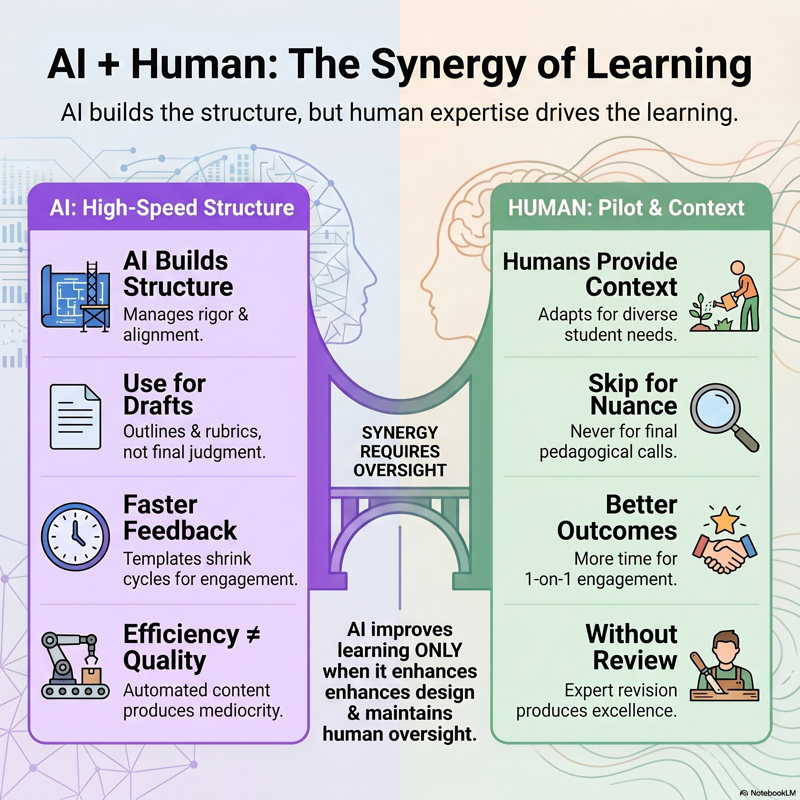
The pattern is clear: AI improves student learning when it improves the course design and when faculty remain actively involved in the process. It doesn't improve learning by itself. It improves learning by making good design practices more achievable.
A Framework for Faculty: When to Use AI and When Not To
Use AI when:
- You need a first draft of structural content (outlines, rubrics, assessment items)
- You're building a new course and need to move from blank page to working draft quickly
- You want to generate multiple options (discussion prompts, quiz questions) and curate the best ones
- You need consistent formatting and alignment across modules
- You're short on prep time but not on expertise
Don't use AI when:
- You need content that requires deep disciplinary nuance that only a specialist can provide
- You're making pedagogical judgment calls about what your specific students need
- The task requires knowing your institutional context, student demographics, or departmental requirements
- You're tempted to skip the review step because the output "looks good enough"
The Bottom Line
AI doesn't improve student learning. Good course design improves student learning. AI makes good course design faster and more accessible — if the faculty member using it brings the expertise, does the review, and makes the decisions.
That's not a hedge. It's the actual finding. The tool doesn't teach. The instructor teaches. The tool makes the instructor's structural work faster so they can spend more time on the work that actually moves the needle: engaging with students, providing feedback, adjusting the course in real time, and bringing their disciplinary expertise to every decision.
The faculty who get the best results from AI aren't the ones who delegate the most. They're the ones who have the strongest opinions about their course and use AI to execute on those opinions faster.
CourseDev generates course structures and module content aligned to your learning objectives — then gives you full control to review, revise, and customize. The design is the starting point. Your expertise makes it a course. Try it free.